
Location
Ixil and Ixcán area (Quiché), Huehuetenengo, Chimaltenango and Rabinal (Baja Verapaz), where communities that suffered from the scorched earth policy carried out by the Guatemalan state during the Internal Armed Conflict are located.
Area of work and rights defended
The Association for Justice and Reconciliation (AJR) is a coalition of survivors from 22 communities in five regions of the country that suffered the scorched earth policy between 1978 and 1985. Since its constitution, before the complaints were filed in 2000, they have been seeking justice for the multiple human rights violations they suffered: massacres, assassinations, rape, forced displacement, destruction of their livelihoods and way of life, etc. In 2000, they became co-plaintiffs in the genocide complaints filed against the military governments of Romeo Lucas García and Efraín Ríos Montt.
In 2013, the first trial was held for the Genocide against the Ixil People during the government of General E. Rios Montt, which concluded with a conviction against the former de facto president for the crimes of Genocide and Crimes against the Duties of Humanity. Only 10 days after the sentence was issued, it was suspended by a resolution that has been described by experts as illegal, and a repetition of the debate was demanded. This re-run began in January 2015 and in September 2018 it was again concluded that Genocide did take place. However, by then the accused, E. Ríos Montt, had been dead for 5 months, and the second accused, General José Mauricio Rodríguez Sánchez, former director of military intelligence, was again cleared of the charges. Both sentences are historic because, for the first time in the world, a head of state is tried and convicted of genocide in his own country.
Both sentences are historic because, for the first time in the world, a head of state is tried and convicted of genocide in his own country.
Description of the problem
Since January 2024 the AJR, represented by the Human Rights Office of the Archbishopric of Guatemala (ODHAG), has been awaiting the opening of the oral and public debate of a second trial for the Genocide against the Ixil People, this time from the time of the government of R. Lucas García. The accused is the retired general and brother of the then president, Manuel Benedicto Lucas García, former head of the Presidential General Staff between 16 August 1981 and 23 March 1982. He will be tried for the crimes of genocide and crimes against humanity, forced disappearance and sexual violence.
According to the AJR and ODHAG communiqué of March 21, Lucas García “from his position as Operational Commander of the Guatemalan Army, identified the Mayan peoples of the country as enemies of the State. He ordered the implementation of military sweeping operations in the municipalities of Santa María Nebaj, San Juan Cotzal and San Gaspar Chajul, causing the death of a minimum of 1771 people, 1172 reported with names and surnames, among them girls, boys, old men and women, men, women, including pregnant women, in more than 32 selective and widespread massacres, destruction of more than 23 entire villages including the burning of houses, crops, sowing, work tools, persecution, forced displacement and bombings, as well as the subjection of the population to conditions of hunger and disease that caused the death of hundreds more people, in addition to serious acts of sexual violence against women and girls and the forced disappearance of local leaders”.
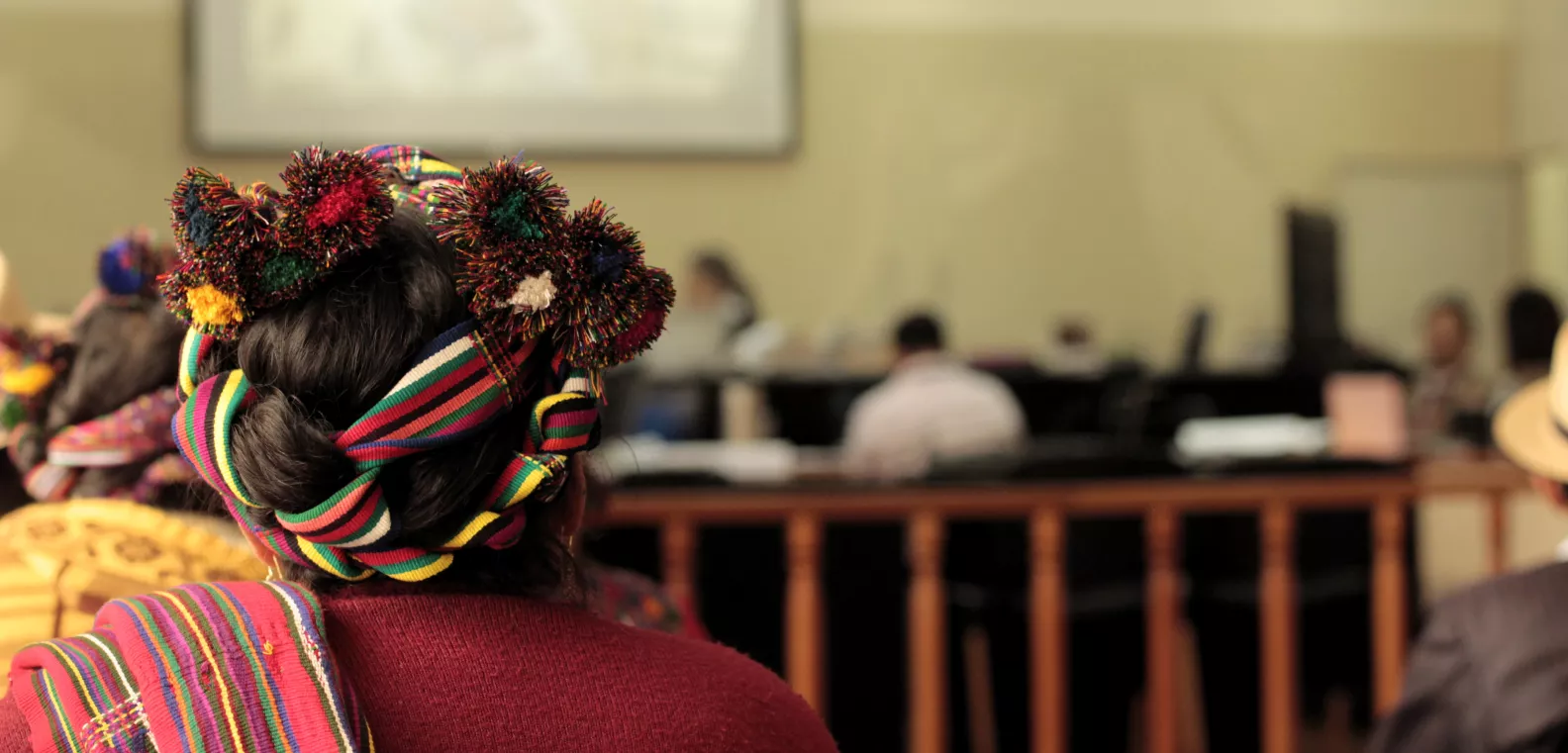
Over the course of almost 100 hearings held from April to November of 2024,1 the Public Prosecutor’s Office (MP) and the plaintiff AJR, represented by lawyers from the Center for Human Rights Legal Action (CALDH) and the Human Rights Office of the Archbishop of Guatemala (ODHAG), presented 71 testimonies (including from 11 women survivors of sexual violence), 42 forensic expert reports, 13 expert reports from other disciplines, military and civilian documents from the relevant period and the Historical Clarification Commission (CEH) report, as well as international court rulings on crimes against humanity. In their statements and during the closing arguments, the MP’s Human Rights Prosecutor and the joint plaintiff presented the events that took place between August 1981 and March 1982 and demonstrated that crimes had been committed, requesting a sentence of “30 years for the crime of genocide, 30 years for crimes against humanity and 40 years for each forced disappearance, 70 proven cases, for a total of 2860 years.”
However, in final days of closing arguments by defense counsel, provided by the Institute of Public Criminal Defense (IDPP), the defense informed the judge that they had been notified of an injunction granted to Lucas García, recusing the judges. Finally a appeals court concluded that “the court showed partiality and bias in favor of the MP and the plaintiffs” and that another court should therefore be assigned to hear the case. The CC confirmed this resolution. A new tribunal will have to be constituted.
In September 2025, another trial for genocide and crimes against humanity was to begin against Luis Enrique Mendoza García, director of the S-3 Operations Section of the General Staff of the Army during the de facto government of Ríos Montt (1982-1983). He was not tried in the first trial in 2013 because he was a fugitive. He was captured in 2019 and prosecuted. The hearing to begin oral and public debate was suspended on two occasions and was finally rescheduled for April 27, 2026.
The hearings are broadcast by the media outlet of Verdad y Justicia.
PBI began accompanying the AJR Board of Directors in April 2024 for the judicial process against Lucas García.