
[published in Bulletin no 50]
At the beginning of 2023 we began our accompaniment of the Association of Relatives of the Detained and Disappeared of Guatemala (FAMDEGUA). This accompaniment is not entirely new, as we had already accompanied this organization in the early 1990s. In fact, one of the first organizations we accompanied in Guatemala was the Mutual Support Group (GAM), from which FAMDEGUA was founded in 1992. Its founding members included Aura Elena Farfán (sister of Rubén Amilcar Farfán, a student at the University of San Carlos), Blanca Rosa Hernández (mother of Oscar Hernández, a firefighter) and Marcia Méndez (sister of Luz Haydée Méndez, a student and mother). They, along with other sisters, mothers, fathers, daughters and sons of disappeared persons, began their tireless search for their loved ones from the early 1980s onwards. Since then, they have provided moral and legal support to a multitude of families and communities that suffered all kinds of human rights violations perpetrated by state forces during the cruelest years of the Internal Armed Conflict (IAC).
Of all the families and communities impacted by the IAC, the survivors of the Dos Erres massacre, a community located in the municipality of La Libertad, department of Petén, stand out. This massacre was perpetrated on 6, 7 and 8 December 1982 by some 50 Kaibiles (an elite army corps), who dressed up as guerrillas to confuse the population. They assaulted, tortured, raped and killed more than 200 people and threw their bodies in a well. Between 1994 and 1995 FAMDEGUA carried out the first exhumation of the victims’ remains. The people involved in this process received multiple death threats. Investigations into the crime dragged on without result, so in September 1996 FAMDEGUA decided to bring the case before the Inter-American Commission on Human Rights and before the Inter-American Court of Human Rights (IACHR) in 2008. In November 2009, the Court concluded that the Guatemalan state had failed to comply with its obligations in relation to these “grave human rights violations”, in particular, the failure to conduct a complete and exhaustive investigation into the massacre and those responsible for it. The IACHR also demanded that the State of Guatemala “initiate exofficio and without delay a serious, impartial and effective investigation into all the incident of the massacre related to the violation of life, as well as other specific violations of personal integrity, such as the alleged torture and acts of violence against women incorporating a gender perspective.”1
After the Court’s judgement, it took two years before, in 2011, Guatemala’s Highest Risk Court A, presided over by Jazmín Barrios, convicted three former Kaibil soldiers and a lieutenant for crimes against humanity and murder. In 2012 and 2018, a former Kaibil sub-instructor and a retired military officer were convicted in subsequent cases. The sentences were set at between 5,000 and 6,000 years’ imprisonment. 2
This year, 2023, three more former Kaibiles were accused of having participated in the same incidents. However, the High Risk Court E, presided over by Abelina Cruz Toscano alongside Otoniel de León and Alida Mariluz Valenzuela, acquitted the three accused: Gilberto Jordán, José Mardoqueo Ortiz and Alfonso Bulux Vicente. Edgar Pérez, the lawyer representing FAMDEGUA, pointed out that “there are eyewitnesses, there are survivors of the massacre, whose testimonies are not given evidential value due to anti-technical, anti-legal criteria which re-victimize the survivors.” For this reason, they have appealed this sentence and are currently awaiting its resolution.3
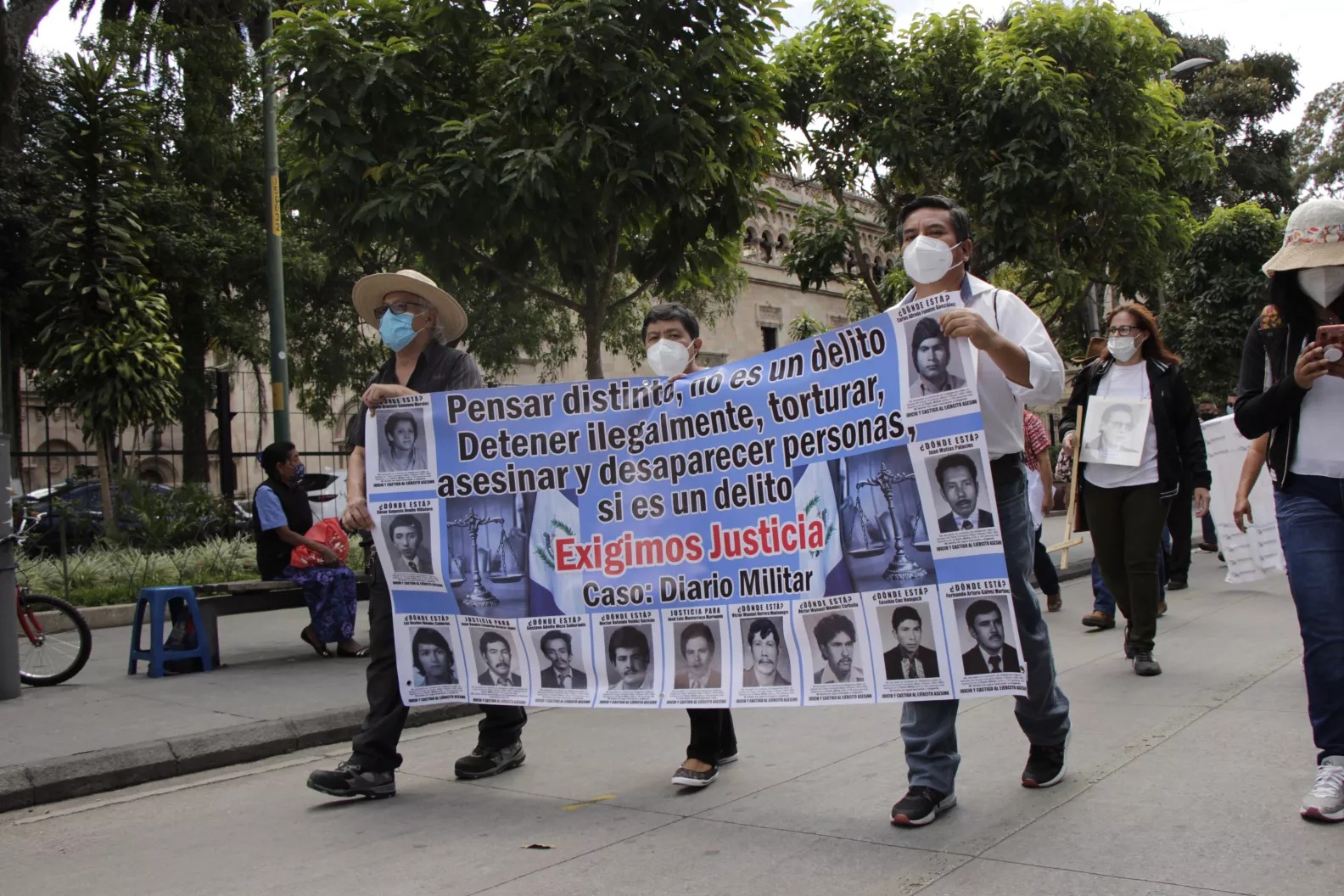
The Military Diary case is another important case for members of FAMDEGUA, whose relatives are actual victims. The accusation includes the forced disappearance, extrajudicial execution, arbitrary detention, torture and sexual abuse of at least 195 people, during the military government of Humberto Mejía Víctores (1983-1986).4 The first statement hearings in this case took place during the first half of 2022 in the High Risk Court A, presided over by Judge Miguel Angel Gálvez Aguilar. Gálvez indicted nine former military and police officers for crimes against humanity, enforced disappearance and other crimes in May of that year. Six months later, in November 2022, the judge was forced into exile due to death threats and the criminalization process led against him by actors linked to military veterans. In 2023, the interim judges who took over the case changed the coercive measures imposed on the defendants to house arrest, basing their decision on the alleged health problems of the defendants and their advanced age, despite the fact that crimes of this nature do not allow for alternative measures. 5.
During this first year we have accompanied FAMDEGUA on several trips to Petén, where the hearings of the Las Dos Erres case took place, as well as to the hearings in the Military Diary case, which took place in Guatemala City. We have also visited them regularly at their headquarters.
1Corte Interamericano de Derechos Humanos, CASO DE LA MASACRE DE LAS DOS ERRES VS. GUATEMALA, 24.11.2009.
2Medinilla, A., Cuatro juicios por la matanza de mas de 200 personas, Agencia Ocote, 04.09.2023.
3Pérez, R., Apelan sentencia de Tribunal que dejó libres a tres exkaibiles en caso Dos Erres, Prensa Comunitaria, 28.11.2023
4Para más información sobre el caso: El poder de la palabra. El legado de Luis de Lión y el caso Diario Militar, en el Boletín 41 de Brigadas Internacionales de Paz, Proyecto Guatemala.
5Burt, J.-M. & Estrada, P., Expediente del Diario Militar es desmantelado por sistemas político-legales corruptos de Guatemala, WOLA, 4.04.2023