
[published in Bulletin no. 55]
Part of the struggle of the Peaceful Resistance of the Poqomam People of Chinautla involves pursuing legal processes to hold state agencies accountable for ensuring that their rights as an Indigenous People and as citizens are respected. In 2021, the Constitutional Court (CC) recognized their right to water; however, no institution took action to ensure that this right was realized. In 2024, the Ancestral Authorities, who are part of the Resistance, filed a lawsuit against the municipality of Chinautla to demand the closure of illegal landfills that pollute the rivers flowing through the area, and the implementation of an ecological restoration plan. In 2025, this lawsuit was resolved in favor of the Resistance when a civil trial court ordered the municipality to assume its responsibility for environmental management, by addressing the damage caused to the Chinautla, Tzaljá, and Las Vacas rivers, closing the illegal dumps, and designing a technical and scientific response plan for the short, medium, and long term.1
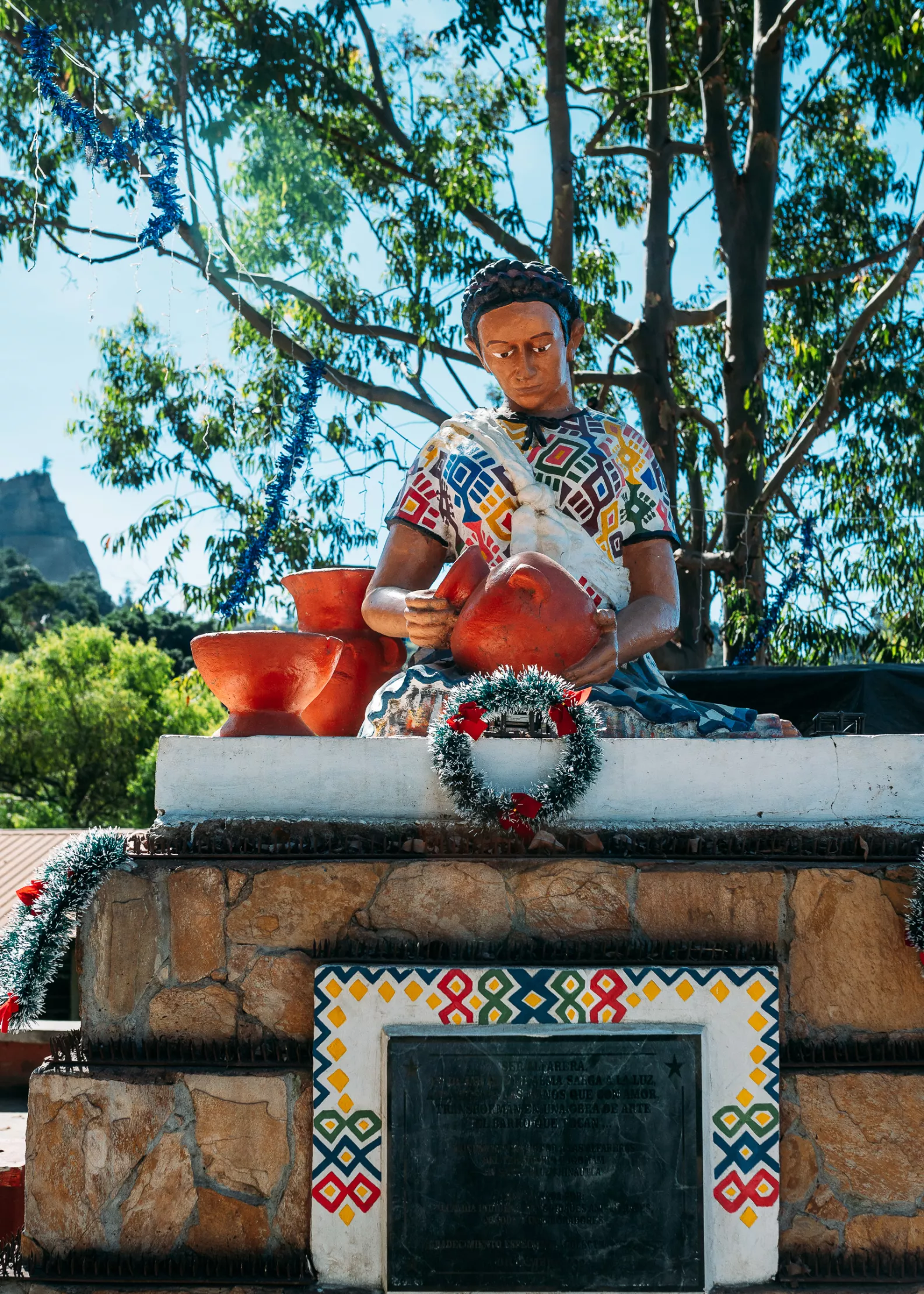
These two rulings led to the establishment of dialogue processes between the parties, aimed at finding solutions to the many problems affecting the Maya Poqomam people in Chinautla. This has taken the shape of monthly roundtable discussions. Representatives of the Resistance attend the discussions and PBI accompanies them there. Only a small number of representatives from the Resistance are allowed inside. Our accompaniment has consisted of going with them to the meeting place and staying outside with those who are waiting for the results of the dialogue, in other words, the women potters, who sustain much of this peaceful struggle. Each time a roundtable discussion is held, the women wait at the door for hours to show solidarity with those inside. During these long waits, we take the opportunity to talk with some of the women – specifically Estefanía, Justina, and Rosario2 – who tell us about their struggle, the challenges they face, and the effort it takes to keep it going.
For years, the women potters have accompanied the Resistance’s leadership board and organized protests to speak out about extractive companies’ impacts in Chinautla. They have held encampments in front of the sand quarries and along the road where trucks travel each day, transporting materials extracted from the area and creating a constant cloud of dust that seriously harms the population’s health. This is an entirely volunteer effort; in other words, they are giving their time, energy, and resources to defend their community.
For these women, going to the roundtable meetings means starting their day before dawn. They get up around four in the morning to get a head start on their housework and take care of their household’s needs. If they’re lucky, they stock up on water while it’s available, since it’s only provided every two weeks. Then they set out for Guatemala City. Sometimes one of the women’s husbands, Don Teodoro, drives them in his pickup truck; other times they have to take the bus. They arrive around nine in the morning and wait outside the meeting rooms until four in the afternoon, rain or shine. The return trip usually ends sometime after six in the evening.
Despite the effort, time, and exhaustion this involves, they continue to attend these meetings because they see them as an opportunity for change, a chance to demand solutions to the dire situation they face in their community, where river pollution and environmental damage caused by the sand quarries make life very difficult. “The sand quarries are monsters that have destroyed our town. Many of our grandchildren don’t know the intact hills or the clean water that the older people remember,” says Justina. Environmental damage has profoundly transformed the landscape and the community’s way of life. The women remember a different landscape, with hills that have now partially disappeared, with vegetables, edible plants, and medicinal herbs growing along waterways and with clean rivers where they used to bathe without a care. They know they will not be able to recover everything they’ve lost, but they hope that the roundtable discussions will serve as a tool to prevent the damage from continuing to spread.
They tell us that the dialogue process has also been marked by disappointment, as they often feel they are not being heard. It pains them that the authorities keep them out of decision-making spaces and that the Ministry of Energy and Mines (MEM) does not provide them with clear answers or the respect they deserve. This sense of exclusion is compounded by the criticism they face within their own community. Some people question the Resistance’s work, gossip about them, or downplay their efforts. They acknowledge that all of this sometimes makes them want to walk away. However, they believe that if they abandoned the process, it would mean leaving unfinished a struggle they have sustained for more than a decade.
The women participate in trash cleanup days as part of the commitments and actions agreed upon during the roundtable discussions. They consistently collect trash that has been carried downstream by the river, even though they know that much of it comes from the Zone 3 garbage dump and that, sooner or later, it will reappear downstream. The women participate in trash cleanup days as part of the commitments and actions agreed upon during the roundtable discussions. They consistently collect trash that has been carried downstream by the river, even though they know that much of it comes from the Zone 3 garbage dump and that, sooner or later, it will reappear downstream. Many people tell them they are “playing” at collecting trash. Others blame them for the pollution. However, for them, these cleanup efforts are a form of protest and a way to restore dignity to their territory. Collecting the trash does not mean they accept the problem as their own, as if they were responsible for it; instead, it shows that responsibility for the river’s pollution extends far beyond the individual actions of communities living along the riverbanks.
But there is also room for hope. As a result of the Resistance’s struggle, some changes have already begun to take place. Cleanup efforts in certain areas have improved, and the municipality is conducting trash collection days more frequently. However, the women believe that these efforts are still insufficient and that the institutional response does not reflect the gravity of the situation. One clear example is the reconstruction of damaged infrastructure, which the authorities have not addressed: “The government isn’t doing anything, so we’re building the bridge ourselves.” Furthermore, during the reconstruction of this bridge, which crosses the Las Vacas River, people questioned how slowly the work was progressing without realizing how difficult the project was and how little support they received from the municipality. They were even subjected to insults while delivering food to those doing the work. However, few people realize that it is the members of the Resistance themselves who are doing the work: they transport materials, organize tasks, and directly contribute to projects aimed at improving conditions in the community.
They do not like feeling abandoned by the government. They wish decision-makers could personally experience the consequences of the pollution they face every day, see their children get sick, and watch their land deteriorate year after year. “The people in power have their mansions—what about us?” Rosario asks. However, despite everything, they hold onto hope.
A key moment for the Resistance was the May 2026 decision by the Ministry of Environment and Natural Resources (MARN) to revoke the environmental license for the San Luis gravel quarry. Although they know that this decision will not bring back their lost hilltops or immediately restore damaged ecosystems, they see it as an achievement resulting from years of complaints and activism, saying “the struggle has not been in vain.” They also note that many of the sand quarries are running out of resources to extract, since “there is no more white clay.” For the women, this highlights the scale of the extraction, which has transformed the region over the course of decades and left them without the raw material that sustains their livelihoods: clay, the foundation of pottery-making.
Despite all the difficulties and dire situations they face on a daily basis, they believe that the very existence of these roundtable discussions represents a victory, as these spaces did not exist before and now allow them to call for answers and keep the discussion about the future of their territory alive. The women potters want lasting solutions to the trash problem, effective recycling systems, and concrete actions to save the river. They know that collective struggle is essential to achieve these goals. The community they have built, and their mutual support are what enable them to move forward with the hope of securing a pollution-free future for their children in Chinautla, territory of the Poqomam people.
1For more information, see: PBI Guatemala, Peaceful Resistance of the Poqomam People of Chinautla, Annual Report 2025.
2Interviews conducted during accompaniment visits in June 2026.