
Between December 6 and 8, 1982, the Dos Erres massacre took place in the municipality of Las Cruces, department of Petén. An elite army commando unit, the Kaibiles, disguised as guerrillas, blocked the exits of the small village of Dos Erres to prevent its inhabitants from escaping. At dawn, they took the people out of their homes: the men were rounded up in the central square, while the women and children were locked in the church and school. For three days and two nights, state forces assaulted, tortured, raped, and killed more than 200 people. They threw their bodies into the village well.
From 1994 to 1995, the Association of Relatives of the Detained and Disappeared of Guatemala (FAMDEGUA) sought to carry out the first exhumation, which led to death threats against them. Given the lack of progress in the courts, they took the case to the IACHR in 1996. In 2008, they brought the case before the I/A Court H.R. In 2009, the Court concluded that the Guatemalan State had failed in its obligation to investigate, ordering the State to take legal action with a focus on gender.
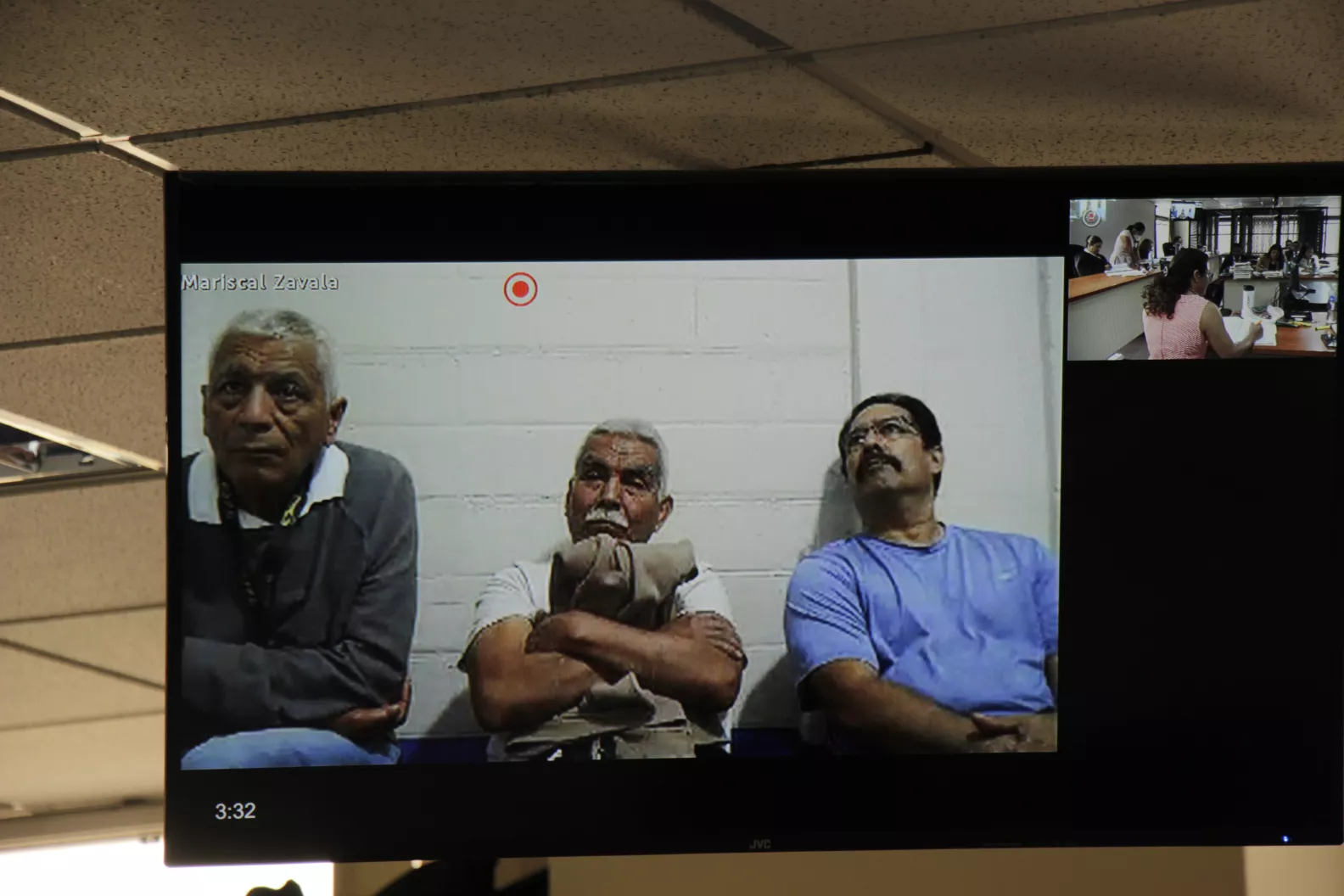
In 2011, following the investigation and corresponding court proceedings, the Guatemalan judicial system’s High Risk Court A handed down its ruling in this case and sentenced three former Kaibiles, Manuel Pop, Reyes Collin Gualip, and Daniel Martínez Hernández, and Lieutenant Carlos Carías to more than 6,000 years in prison. Furthermore, in 2012, Pedro Pimentel Ríos, a former instructor at the Kaibil School, was convicted. In 2018, Santos López, a former Kaibil, was also convicted. Both received sentences similar to those of the other defendants.
However, in 2023, High Risk Court “E” acquitted three former Kaibiles Gilberto Jordán, José Mardoqueo Ortiz, and Alfonso Bulux Vicente, despite survivor testimony directly identifying the perpetrators. In addition, the Court ordered that the evidence presented at the trial be destroyed. FAMDEGUA appealed both decisions, arguing that they were revictimizing and lacked technical and legal justification. The appeal is still pending. Meanwhile, the Inter-American Court of Human Rights ordered that the evidence be preserved.