
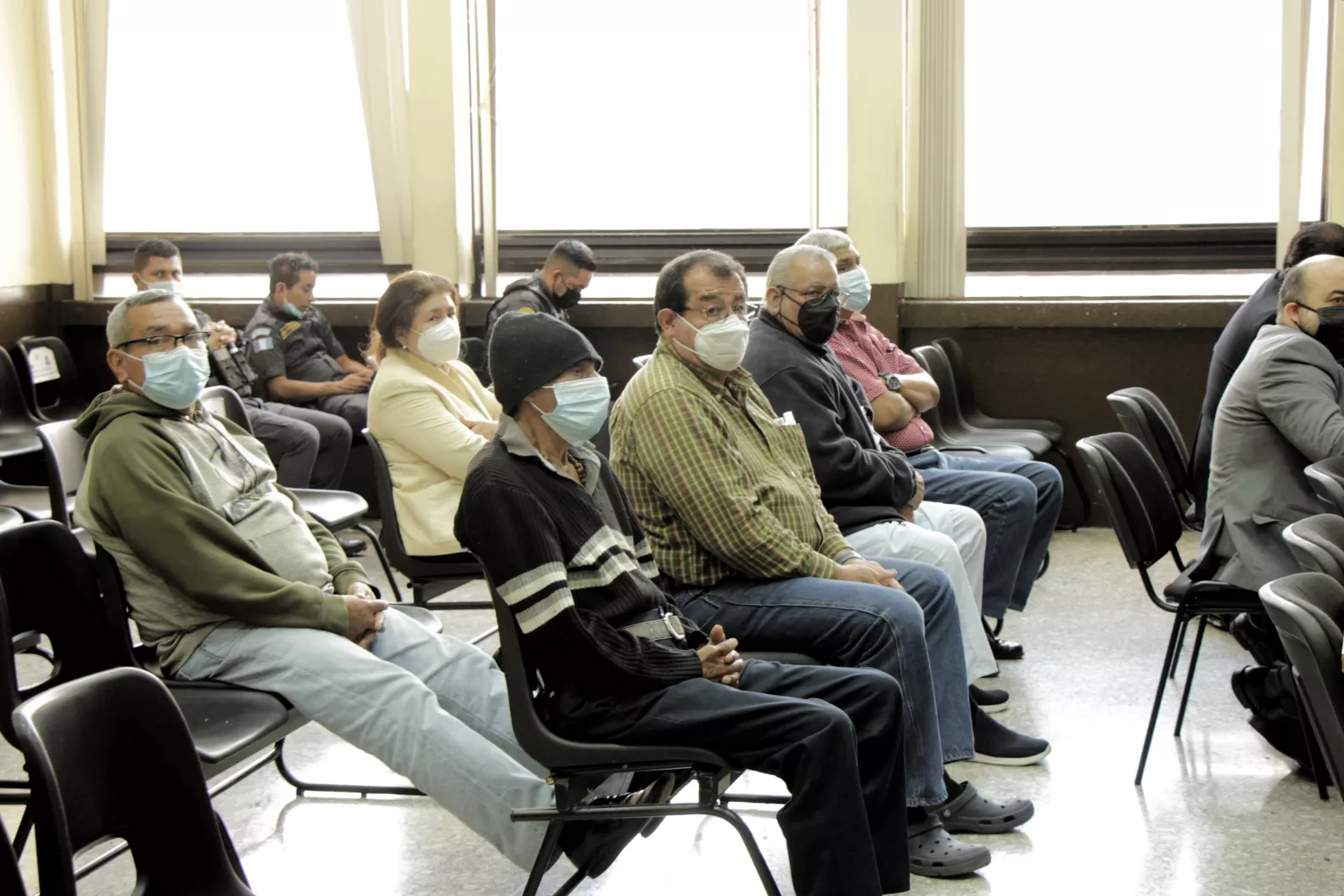
The Military Diary case highlights the systematic practices of repression employed by the Guatemalan state during the IAC. The Military Diary case highlights the systematic practices of repression employed by the Guatemalan state during the IAC. The Military Diary is a military document that came to light in 1999, containing the names, photographs, and personal details of 183 people who were captured by armed agents and, in most cases, murdered. n 2005, when the Historical Archive of the National Police was discovered, it was possible to corroborate the veracity of the information recorded in the document.
After the Military Diary was published, organizations representing the families of missing persons whose names appear in the document filed a complaint with the Public Prosecutor’s Office. The organizations involved are: the Mutual Support Group (GAM), the Association of Relatives of the Detained and Disappeared of Guatemala (FAMDEGUA), and the Myrna Mack Foundation. The complainants also included an institution, the Human Rights Ombudsman’s Office (PDH). In 2005, faced with a lack of progress in the case, these organizations filed a complaint with the IACHR. And in 2011, they brought the same case before the I/A Court H.R., alleging the disappearance of 26 of the people identified in the Military Diary.
In 2012, the I/A Court H.R. presented its conclusions, highlighting the lack of diligence and efficiency in the MP’s efforts to clarify the events and identify and punish those who might be responsible. The Court also highlighted the Ministry of Defense’s failure to cooperate with the MP’s investigations. The Court found the Guatemalan State responsible for the forced disappearance of the 26 individuals and ordered the State to carry out the necessary investigations to locate the disappeared, as well as to prosecute and punish those responsible for the crimes.
In 2021, Judge Miguel Ángel Gálvez indicted nine former military personnel on charges of forced disappearance, murder, attempted murder, and crimes against humanity, and sent six of them to pretrial detention. As a result, the judge was subjected to a campaign of constant surveillance and intimidation, mainly by the FCT, which also filed a complaint against him in order to strip him of his right to judicial immunity.1 In 2022, Gálvez resigned and was forced into exile. Since then, several of the defendants have benefited from alternative measures ordered by Gálvez’s successors in High Risk Court “B” and remain under house arrest. Marco Antonio González Taracena, former Minister of Defense, died without ever facing trial.
During the most recent hearings in the intermediate phase of the 2025 case, the actions of the MP’s prosecutor, José Crisanto Gómez Meléndez, raised concerns. Gómez Meléndez asked for the provisional closure of the proceedings and changes in the classification of the crimes, despite the fact that the charges against the defendants are supported by more than 7,000 pieces of evidence, including 100 statements and records of people executed by the State. The organizations of victims and survivors who are plaintiffs in the case requested that the Attorney General remove the prosecutors from the case. According to FAMDEGUA representative Santiago Choc, the MP’s actions represent a violation of the I/A Court H.R.’s ruling.2
1In July 2025, the prosecutor investigating this complaint concluded that there was insufficient evidence to prove that crimes had been committed and sought to dismiss the case. She was immediately reported by the FCT, and the MP withdrew the motion to dismiss. Osegueda, S., Presionados por la FCT, el MP ahora cambia de rumbo: aquí el informe que pedía cerrar el caso contra el exjuez Gálvez, La Hora, 24 Jul 2025.
2Valdéz, A. Representantes de las víctimas piden apartar a los fiscales del caso Diario Militar, Prensa Comunitaria, 14 Oct 2025.