
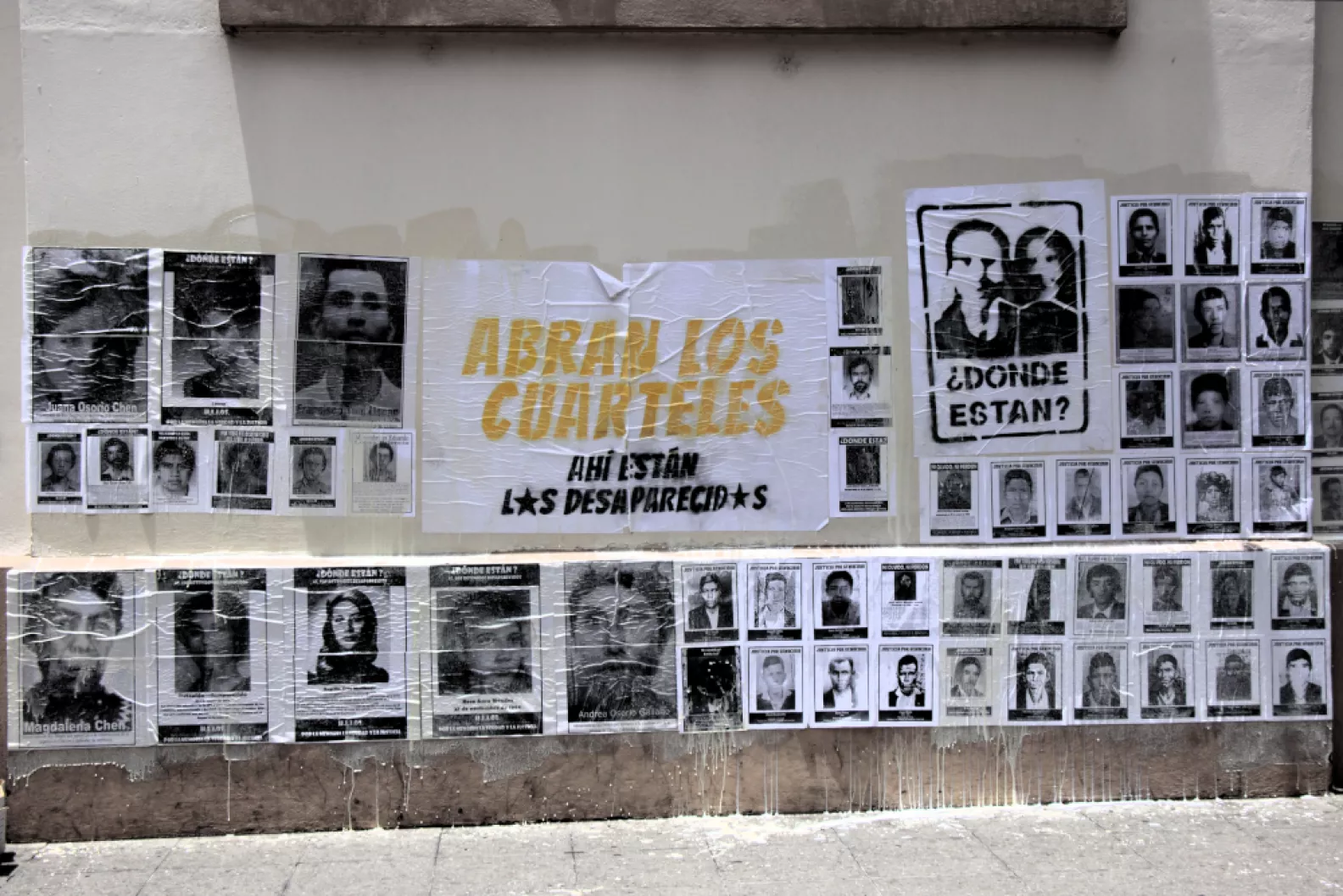
On December 29, 1996, the Government of Guatemala and the Guatemalan National Revolutionary Unity (URNG) signed the “Accord for a Firm and Lasting Peace,” ending 36 years of internal armed conflict (IAC) in Guatemala. The Peace Accords recognized the need to act “firmly against impunity,” as well as the “humanitarian duty [to] compensate and/or assist victims of human rights violations.”1 Likewise, they affirmed the “right of the Guatemalan people [to] know the full truth about human rights violations and acts of violence that occurred in the context of the internal armed conflict.”2
Survivors and victims fight for justice
Progress in transitional justice—whose four component parts are justice, truth, reparation, and non-repetition—has not been achieved because of the commitments made by the State following the signing of the peace accords, but rather thanks to the tenacious struggle of families and organizations of victims from the IAC. In the 1990s, driven forward by these collectives and their lawyers, legal proceedings began to address the different crimes committed during this bloody period in Guatemala’s history: dispossession, murders, sexual violence, kidnappings, disappearances, massacres, and genocides. However, investigative efforts faced obstacles, irregularities, and setbacks, including the exclusion of initial charges and material and intellectual authors, as well as repeated trials to remedy obstructions committed in the initial phases.
Notable examples of the first legal proceedings for war crimes include:
- Torture, extrajudicial executions, forced disappearances, and rapes committed between April 1982 and January 1983 in Tululché, Chiché, led by military commissioner Candido Noriega and carried out by military commandos and civil self-defense patrols (PAC). The legal proceedings against Noriega, brought by the National Coordination of Widows of Guatemala (CONAVIGUA), lasted from 1992 to 1999 and ultimately led to a sentence of 220 years in prison for six of the 156 charges originally brought against him. He served only 15 years before being pardoned for “good behavior.”3
- Jesus Tecu Osorio, one of the survivors of the Pak’oxom massacre in Rio Negro, began legal proceedings in 1993 against three of the approximately 50 PACs who committed this massacre. In 1999, they were sentenced to 60 years in prison (the Commission for Historical Clarification - CEH - documented a series of massacres in the Rio Negro region between 1980 and 1982, including the Pak’oxom massacre, in which some 500 people were killed in the context of the construction of the Chixoy hydroelectric dam.) 4
- The murder of anthropologist Myrna Mack, perpetrated by state security agents in 1990. Thanks to the relentless efforts of her sister Helen Mack, the perpetrator, Army specialist Noel de Jesús Beteta Álvarez, was convicted in 1994. However, it was not until 2002 that a court convicted the director of the Department of Presidential Security of the Joint Chiefs of Staff, Juan Valencia Osorio, as the intellectual author. On the other hand, two other military personnel, Edgar Augusto Godoy Gaitán and Juan Guillermo Oliva Carrera, were acquitted. Valencia Osorio is currently a fugitive.5
Due to the lack of progress in investigations and proceedings within the Guatemalan judicial system, dozens of lawsuits were filed with the Inter-American Commission on Human Rights (IACHR) and the Inter-American Court of Human Rights (I/A Court H.R.). These proceedings have resulted in 15 sentences condemning the State of Guatemala for its responsibility in the incidents reported. As part of these rulings, the Court ordered the Guatemalan State to acknowledge its responsibilities, conduct the necessary investigations, prosecute those responsible for the crimes reported, and take measures to provide adequate reparations.
The Public Prosecutor’s Office accepted its role
According to Raúl Nájera,6 a researcher at the Human Rights Office of the Archdiocese of Guatemala (ODHAG), the greatest progress on legal proceedings for human rights violations committed during the IAC was made during the presidency of Álvaro Colom (2009-2013), after José Amílcar Velásquez Zárate took office as Attorney General (AG) and Head of the Public Prosecutor’s Office (MP), and took the first steps towards making the MP independent of political and economic interests. But the most significant progress came in 2010 when renowned human rights defender Claudia Paz y Paz was elected AG, serving in the position between 2010 and 2014. In 2011, Paz y Paz ordered the creation of the IAC Special Cases Unit within the MP to move these cases forward and comply with the rulings of the I/A Court H.R. Both the Human Rights Law Firm (BDH)7 and ODHAG agree that she did a remarkably good job and enjoyed broad support from civil society, the international community, and the International Commission against Impunity in Guatemala (CICIG). She strategically focused on training prosecutors and increased the number of members on the investigation teams.
Paz y Paz will be remembered as the AG who, in 2013, brought dictator José Efraín Ríos Montt to justice for genocide and crimes against humanity, achieving a conviction. This trial was unprecedented in any country in the world, as it was the first time that a former head of state was tried and convicted of genocide in a court in his own country. However, the sentence was overturned after 10 days. In 2018, with Ríos Montt already dead and after repeating the trial, a national court again concluded that genocide had been committed against the Maya Ixil ethnic group. The general had died a few months earlier, having spent no more than a few days in prison. Even so, for the Association for Justice and Reconciliation (AJR),8 “it has been officially recognized that genocide did occur in Guatemala. […] This ruling is a milestone in Guatemala; not only the AJR, but also several victims’ and families’ organizations have managed to bring the facts to light and put the national justice system to the test.” It also highlights that the ruling has brought about a change in the collective imagination, as “it cannot be denied that they [the army] were the ones who planned and carried out the crimes, and not the guerrillas.”
Lucrecia Molina Theissen, 9 who has spent decades seeking justice for the disappearance of her little brother Marco Antonio, explains that trials allow “the masks to be removed from the perpetrators” who, while benefiting from impunity, claim to have “saved Guatemala from communism.” She also emphasizes the restorative impact of the sentences, mentioning the case of her sister Emma Guadalupe, who “recovered in an incredible way” after living for decades with feelings of guilt related to her brother’s disappearance. “The impact of the court cases even extends to the collective level, as they allow truths shared by tens of thousands of victims to be brought to court. Finally, the expert reports and testimonies presented at the hearings contain a wealth of knowledge that contributes to an understanding of the historical factors and context in which countless gross human rights violations were committed.”
The reaction from sectors of impunity
By 2015, organizations and family members of victims and survivors had already won several court cases for crimes against humanity, involving high-ranking military officers as the defendants. Furthermore, the newly created Special Prosecutor’s Office Against Impunity (FECI) of the MP – at that time under the leadership of AG Thelma Aldana (2014-18) – in collaboration with the CICIG, uncovered corruption within the judicial, political, and business sectors. Suddenly, members of the families that owned Guatemala’s largest companies, politicians, and judges were under investigation for large-scale acts of corruption.
In 2018, then-President Jimmy Morales—whose son and brother were under investigation by the FECI and CICIG—appointed María Consuelo Porras Argueta as AG. She was re-elected in 2022 by Morales’ successor, Alejandro Giammattei. The aforementioned sectors, once untouchable until the CICIG came along, were now being investigated and prosecuted for their corrupt acts, which led them to form a common front known as “the pact of the corrupt,” with the aim of forcing the CICIG out, a goal which they achieved in 2019. The Congress of the Republic illegally failed to renew the Supreme Court of Justice (CSJ), and in 2020 a Constitutional Court (CC) aligned with reactionary sectors was elected. In 2021, the FECI was dismantled following the removal of its head, José Francisco Sandoval, who was pursuing investigations into corruption involving, among others, then-President Giammattei. The Foundation Against Terrorism10, whose legal complaints against justice operators and human rights defenders had previously been rejected, found support in Porras’s MP and were accompanied by a violent campaign of character assassination, intimidation, criminalization, and prosecution against justice operators and former CICIG collaborators, resulting in spurious accusations. Judges sympathetic to the MP brought these people to trial and sent them to preventive detention, where they spent months, and even years, while the justice system maliciously dragged out the proceedings by suspending hearings, filing legal appeals, delaying the formation of courts, etc. As a result, more than 100 people, including prosecutors, judges, and journalists who had dedicated their professional lives to fighting corruption, were forced into exile.11
This chain of events has profoundly affected the rule of law in Guatemala and, as a result, cases for war crimes and crimes against humanity. Furthermore, between 2019 and 2023, several institutions responsible for promoting and monitoring commitments entered into under the Peace Accords, such as the Presidential Commission on Human Rights (COPREDEH), the Secretariat for Peace of the Presidency of the Republic (SEPAZ), and the National Reparations Program (PNR), were dissolved. According to the AJR, the Giammattei government’s closure of these institutions buried the commitments made in the Peace Accords and halted national efforts to provide reparations to the victims of the IAC.
At the end of 2024, AG Consuelo Porras dismantled the Human Rights Prosecutor’s Office and appointed Noé Rivera as its head. Rivera is a prosecutor who has led several investigations against former prosecutors and former CICIG employees and is included on the U.S. State Department’s Engel List for being “a corrupt actor who undermines democratic processes in the country.”12 Faced with this situation, several national and international organizations denounced “openly illegal actions that contravene international standards of justice [which] translate into a pact of impunity for human rights violators and war criminals and, above all, an insult to the families of the victims.”13
José Silvio Tay expresses regret that “the few prosecutors who did their job well […] were subsequently persecuted, criminalized, and several of them had to go into exile.” Between 2021 and 2025, 105 prosecutors were fired by the MP, 85 without just cause, according to a study by Argentina’s Institute for Comparative Studies in Criminal and Social Sciences (Instituto de Estudios Comparados en Ciencias Penales y Sociales, INECIP) and the Guatemalan organization Alliance for Reforms (Alianza por las Reformas).14
Commitments made under the Peace Accords also face significant setbacks in terms of the right to reparations for the harms committed. The PNR, which was created in 2003, was closed in December 2023.15 Since then, there has been no reparations program, although the current government announced the creation of a National Plan for Dignity and Reparations for Victims of the IAC16 that would provide continued assistance to victims. The AJR is currently coordinating with the National Platform of Victims to make progress on this issue. Although the current administration appointed the Presidential Commission for Peace and Human Rights (COPADEH) as the institution responsible for implementing the comprehensive reparations plan, COPADEH claims it lacks the legal and financial resources to do so. AJR points out that “while there is no progress on reparations, the government is illegally using public funds to compensate victims in the form of reparations for former military personnel.”17 Indeed, every three years, Congress passes a law granting 36,000 quetzals in compensation to IAC military veterans for their participation in reforestation projects. In 2022, Alejandro Giammattei signed the latest of these agreements.18
Systematic revictimization in judicial proceedings
The significant setbacks in transitional justice seen in recent years have had a major impact on victims and survivors. José Silvio Tay notes that the greatest effect is revictimization. Many victims have had to repeatedly testify, such as in the trials against Ríos Montt, Rodríguez Sánchez, Mendoza García, Benedicto Lucas García, and others. “Making victims relive their experiences and testify over and over again in court makes them weary, bored, and causes them to lose interest in a case, no matter how strong they are.” “There are many survivor witnesses who waited to see justice done, but they died waiting.” Many others can no longer attend hearings because they are too old. This is how justice delayed is justice denied: after waiting so long, the witnesses pass away. And that is what they want, for there to be no witnesses left. The longer the trials are delayed, the more likely it is that defendants will die and never face justice. In the Ríos Montt case, despite having been convicted, he did not go to prison, claiming illness. In the Rodríguez Sánchez case, he was acquitted. And in the Mendoza García case, there have been multiple, repeated delays. So, without witnesses, there are no longer any living testimonies.” Of the 270 initial witnesses involved in the Ixil Genocide case, 47 have already died.
According to José Silvio Tay, the different strategies used to delay proceedings prevent “prompt and timely justice. They are malicious tactics designed to prolong the proceedings. It is not that there is no evidence or that the investigations are flawed, but rather that this is a mechanism aligned with the co-optation of the justice system. This demonstrates that the legal proceedings have been co-opted and that the perpetrators of the IAC have connections within the justice system. Of the cases handled by the AJR, only two defendants are still alive. Once they die, there will be no defendants left.”
For the victims of the IAC and their families, the delay in judicial proceedings also prolongs the pain and trauma associated with the crimes committed against them. Lucrecia Molina Theissen explains that, for her family and her father, forced disappearance is associated with feelings of guilt and questions of “what if?”—questions that refer to many circumstances that offer no answers. Furthermore, anyone who challenged the authorities or failed in their duty of obedience faced a social climate of hostility and stigmatization; such issues are characteristic in Guatemala, a country which has been ruled through authoritarianism and fear throughout its history. With regard to what happened during the years of conflict, those in power manipulated the truth—and continue to do so—by placing the blame on the victims, asking, “What was your brother involved in?” To understand what happened, to know who is responsible, and to bring them to justice, we must deconstruct this perverse, yet convenient tactic used to protect their impunity. “In our case,” she continued, “people blamed us, as did some members of our family. Even the leader of a human rights organization said in a press interview that the family fled and left Marco Antonio alone in the house.”
“The sentence was an empty promise”
Among the mechanisms used to obstruct criminal proceedings, the BDH agrees that there is a pattern used to stall cases: the abusive use of injunctions, among other legal actions designed to delay proceedings. Although not intended for this purpose, injunctions have become a mechanism used—and even promoted—by judicial authorities to paralyze In the Ixil Genocide case, the BDH notes that “it must be acknowledged that there has been support and complicity on the part of the State, and that this continues to this day, allowing time to pass until the perpetrators die and the crimes go unpunished.”19
In many cases, revictimization is also the result of the criminalization of victims’ families. Along these lines, Lucrecia Molina Theissen explains that one of the defense attorneys, Karen Fischer, accused them of filing a false report and simulating a crime by stating that “we kidnapped Marco Antonio, took him out of Guatemala, changed his name, and married him to Eugenia, one of my sisters. The complaint was filed with the Metropolitan Prosecutor’s Office two or three days after the May 23, 2018 ruling and is still pending due to malicious litigation. Our legal team informed us that Fischer’s strategy, apparently supported by Consuelo Porras, is to have a prosecutor appointed to investigate this accusation, who then investigates and concludes that there is nothing to be done. Fischer then challenges the prosecutor and another prosecutor is appointed, who repeats the same process—because there is effectively no case, no evidence, and what Fischer claims is completely untrue. Such recusals and new appointments have been used to keep the case open. All of this contradicts the fact that the Guatemalan State acknowledged its responsibility for the forced disappearance of Marco Antonio and accepted the reparations measures ordered by the I/A Court H.R., which include searching for and returning his remains. In addition to the above, an appeals court-with different compositions in 2023 and 2025-granted alternative measures to the four people convicted, despite the fact that national and international legislation does not provide for alternative measures for crimes of the magnitude of those committed against Marco Antonio (enforced disappearance) and Emma (torture, sexual violence, and crimes against humanity). Previously, on March 24, 2023, the I/A Court H.R. had ordered the State that “in order to prevent irreparable harm,” the convicted men could not be granted such benefits. But they appealed to the CC, which illegally ordered the Second Appeals Court to do so under threat of punitive measures against it. In June 2023, Callejas, Lucas, and Gordillo were effectively released. The other convicted man, Zaldaña Rojas, also requested alternative measures and finally received them in April 2025, which came as a huge affront to the family, given that he was the actual perpetrator, the man who broke into the house, held a gun to Marco Antonio’s mother’s head to use her as a shield, and kidnapped the child. Furthermore, in its ruling No. 108 of July 2004, the I/A Court H.R. ordered the Guatemalan State to “locate and deliver the remains of Marco Antonio Molina Theissen to his relatives,” 20 but this has not happened. Lucrecia Molina Theissen believes that “the Guatemalan system is making a mockery of these commitments.” “We received the orders issued by the Inter-American Court related to the monitoring compliance with great sadness, and the State’s reports with rage, as they never say anything new on the matter. The hope, especially my mother’s, was that once the ruling and the reparations were enforced, the justice system would begin to take action and demand that other State institutions pursue the search and recovery of Marco Antonio’s remains. These have been major blows.” Meanwhile, the Molina Theissen family remains in exile, fearing that their return to Guatemala will be used to fuel the theory that Marco Antonio was kidnapped by the family, in order to continue criminalizing them.
The burden falls on civil society and the victims themselves
Given this situation, the AJR can only hope that the political context will change and become more favorable. José Silvio Tay explains that they constantly receive questions such as “How is the case going?” or “What progress has there been?” Sometimes they are even asked directly, “Could it be you who don’t want the case to move forward, rather than the courts?” According to the AJR, they cannot allow themselves to ask for hearings be rescheduled or cases postponed, whether for internal, organizational, and budgetary reasons, as this would be inconsistent with the position they have taken in other proceedings. It would be contradictory for them to demand progress in some cases while requesting delays in others. If delays occur, it must be the courts’ responsibility, not the AJR’s.
Similarly, according to Tay, “initiatives to restore dignity and provide reparations to victims have not been carried out because of the state’s willingness, but because of pressure. For example, in the case of Río Negro [human rights violations caused by the construction of the Chixoy hydroelectric dam], progress has been made thanks to the intervention of the IACHR. It was during the Morales and Giammattei administrations that the Peace Accords were shelved, which is why there is currently no institution responsible for dignity, reparation, and memory. There has been no institution dedicated to this cause, and the few gains that have been made have been due to our political pressure and international political intervention.”
The state has also failed to promote the preservation of historical memory. Existing initiatives come from civil society, such as the Museum of Memory in the Quetzaltenango Intercultural Park, which was promoted by a group of artists and is located in the former Manuel Lisandro Barillas barracks where Emma was held captive. Lucrecia Molina Theissen emphasizes the importance of this space, which she considers “something wonderful, poetic” through which “they transformed the meaning of a building that represented death and torture, which was part of the sinister atmosphere that existed at that time. This is what the people of Guatemala can achieve: a response from young people to atrocities that they never want to see repeated in their country.”21
Another site of memory in state hands is the Historical Archive of the National Police. This archive is unique in Latin America and is invaluable for understanding repressive practices such as political assassinations, kidnappings, torture, and forced disappearances perpetrated by Guatemalan authorities during the IAC. Several civil society organizations are warning about the risk of deterioration of the documents held in the archive’s Documentary Collection and are demanding that the site be turned into a publicly accessible site of memory. The archive, which was at risk of being dismantled during the Morales administration,22 was declared a National Cultural Heritage Site in 2020.23
An uncertain outlook
In the first half of 2026, important elections will be held for the administration of justice: five CC judges, as well as the AG and Head of the MP. According to Raúl Nájera, both are extremely important, and the impact of these elections could last up to 15 years. Lawyer Santiago Choc of the BDH believes that “the person who takes office as AG will likely be compromised, because they will have been selected by a nominating committee made up of different sectors that are not necessarily aligned with the fight against impunity.”
The AJR is also awaiting the change of AG, but they are not very confident that the situation will change: “So far, we don’t know who will be appointed; it could be someone better or someone worse . If someone better takes office, maybe things will change a little; if not, then no. And even if someone with good intentions takes office, they will face pressure and persecution that will prevent them from doing their job. That’s what’s happening with President Arévalo; they’re not letting him do his job.”24
For Lucrecia Molina Theissen, the current context is part of a much broader historical trajectory, marked by the construction of “a system of impunity in the country […] to hide the crimes committed by the state since the 1950s. Power, previously exercised by the military and oligarchs linked to US interests, now also includes drug traffickers and corrupt individuals—the pact of the corrupt—who seize public office to enrich themselves. Unfortunately, we are now witnessing the end of a fleeting moment when we believed that justice had been born in Guatemala. Meanwhile, years of state terror instilled fear in the population. Most people reject the situation, but they do not take to the streets to protest; they condemn corruption, but they do not exercise their citizenship or demand their rights, because doing so unleashes state violence. This has left a deep mark, so much so that terror still runs through the veins of society. Enormous work would have to be done in terms of memory and justice so that Guatemalans can learn about previous generations’ history of struggle and resistance in order to build legitimate, inclusive, irrefutable, and sustainable democratic processes that cannot be overturned by changes in positions of power.”
1Comprehensive Agreement on Human Rights, 29 Mar 1994.
2Accord for a Firm and Lasting Peace, 29 Dec 1996.
3Interview with members of CONAVIGUA, 10 Dec 2025 and del Valle Cobár, R., Asesinatos y violaciones en Tululché, Gazeta, 30 Mar 2029.
4CEH, Guatemala Memoria del Silencio, Tomo VI, Caso Ilustrativo no. 10, Masacre y eliminación de la comunidad de Río Negro, Guatemala 1999.
5Fundación Myrna Mack, Caso Myrna Mack, website accessed on 14 Dec 2025.
6Interview with Raúl Nájera, 26 Sep 2025.
7Interview with Santiago Choc, Human Rights Law Firm (BDH), 25 Sep 2025.
8Interview with José Silvio Tay, Association for Justice and Reconciliation (AJR), 10.09.2025.
9Interview with Lucrecia Molina Theissen, Emma y Marco Antonio’s sister, 29 Sep 2025.
10The Foundation Against Terrorism was created in 2013 by retired military officers to defend military personnel accused of crimes committed during the IAC. Its director and public face is Ricardo Méndez Ruíz, son of the commander of Military Detachment No. 21 in Cobán, Alta Verapaz, and Minister of the Interior under Ríos Montt (1981-82).
11Guatemala Leaks and CONNECTAS, “El ‘francotirador’ de los referentes de la lucha anticorrupción en Guatemala”, El Tiempo Latino, 13 Dec 2022 and el Especial, Connectas.org; No-Ficción, serie de podcast El Experimento, 12 episodios, 2021-2023; Equipo de investigación de Plaza Pública, Perseguidos por el MP: una radiografía de los casos contra más de 117 acusados, Plaza Pública, 2024; OACNUDH, Guatemala: desafíos en la defensa de los derechos humanos 2020 – 2025, Dec 2025.
12Red Nacional de Combate a la Impunidad en Guatemala, ¿Quién es Noé Rivera?, RICIG, 10 Dec 2024.
13DPLF, Ministerio Público busca garantizar impunidad en graves violaciones a los derechos humanos cometidas durante el conflicto armado interno en Guatemala, DPLF, 15 Oct 2025.
14Instituto de Estudios Comparados en Ciencias Penales y Sociales, Alianza por las Reformas, ¿Eficacia o Impunidad? El desempeño del Ministerio Público durante la gestión de Consuelo Porras 2018-2025, INECIP and APR, 2025.
15United Nations High Commissioner for Human Rights, Situation of human rights in Guatemala, OHCHR, 2024.
16Alonzo, C., Presidente ratifica su disposición a trabajar en Plan Nacional de Dignificación y Reparación, Agencia de Noticias Guatemaltecas, 25 Feb 2025
17Interview with José Silvio Tay, Op. Cit.
18Congress of the Republic, Decree 51-2022, 24 Oct 2022.
19Interview with Santiago Choc, Op.Cit.
20Inter-American Court of Human Rights, Molina Theissen v. Guatemala, 21 Aug 2014.
21See our Bulletin 52, dedicated to sites of memory in Guatemala..
22PBI Guatemala, Organizations express concern for the Historical Archive of the National Police, 30 May 2019
23PBI Guatemala ACERCATE podcast 5, 16 Jul 2025 and ACÉRCATE podcast 6, 26 Aug 2025; Doyle, K., Dorfman, C., Invisible, Silenced, and All but Abandoned: The Guatemalan Historical Archive of the National Police on its 20th Anniversary, National Security Archive, 04 Sep 25.
24Interview with José Silvio Tay, Op.Cit.