
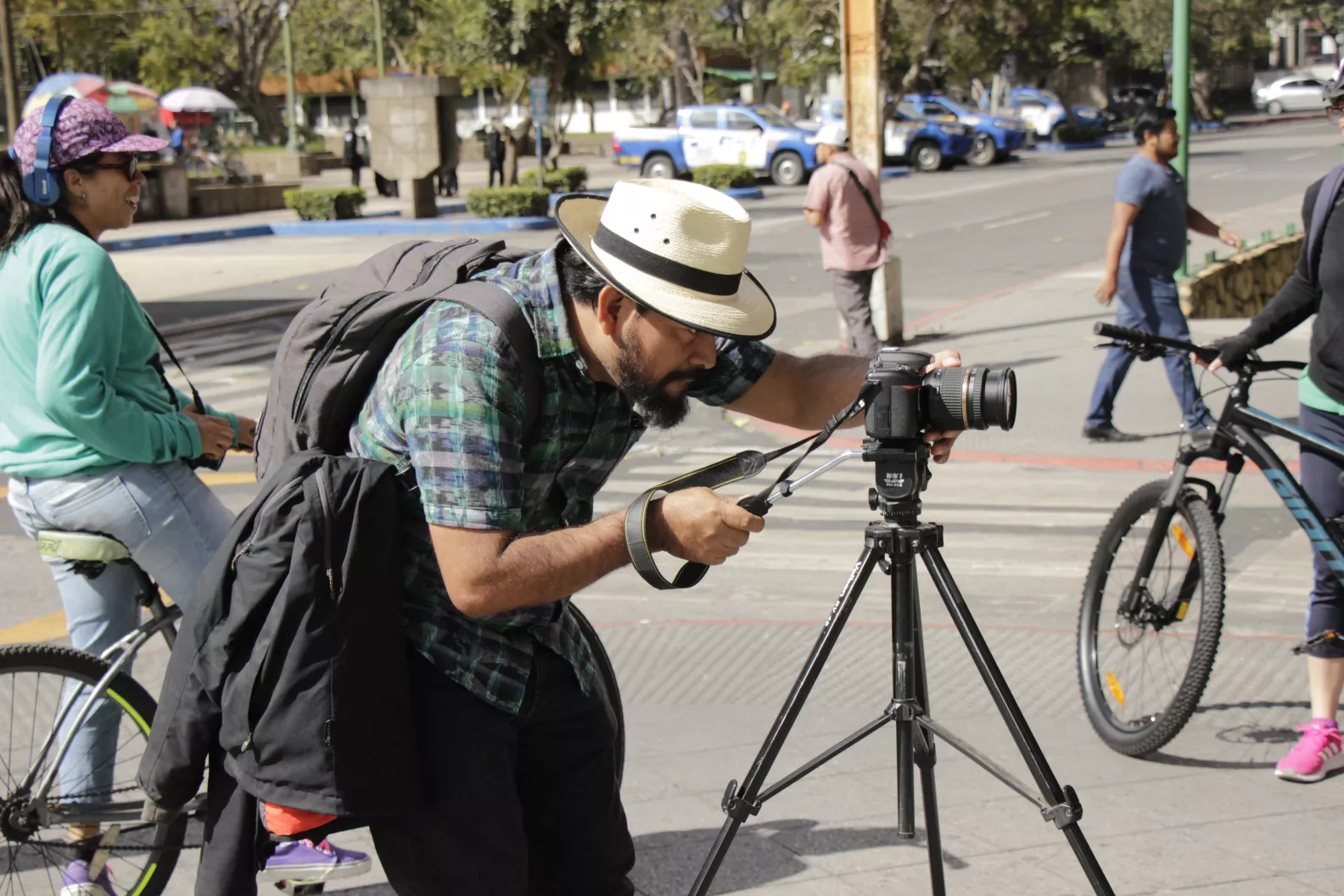
In April 2025, we began accompanying Carlos Ernesto Choc, a Maya Q’eqchi’ journalist who mainly works in the municipality of El Estor, Izabal. His career highlights include his participation in Green Blood and Mining Secrets, investigative journalism projects that revealed the environmental damage caused by the nickel company Solway Investment Group, which operates the largest mine in Central America. His work on these projects was published in various international news outlets, as well as in the Guatemalan media outlet Prensa Comunitaria. Carlos’s work in defense of the environment and human rights has led him to face serious risks: intimidation, threats, all kinds of harassment, criminalization, and prosecution. All of this forced him into temporary exile last year. PBI’s accompaniment is part of his security strategy and helps open up spaces to visibilize his struggle. “You have to reinvent yourself and create a new dynamic. That’s why I approached PBI and asked for support, so that I could continue my work as a journalist and show them that I’m not alone.”
Investigative journalism and speaking out about human rights abuses have always been a risky business in Guatemala. In 2017, the levels of violence against Carlos Choc reached a new dimension. At that time, the journalist was criminalized and prosecuted after documenting the death of fisherman Carlos Maaz during protests over the pollution of Lake Izabal. The community accused the Fenix mining company, operated by the Compañía Guatemalteca de Niquel (CGN) and a subsidiary of the Solway Investment Group, of being responsible for the appearance of a red slick on the lake, caused by toxic waste dumping. “Guatemala is experiencing a fourth invasion: first the Spanish, then the Germans, then the internal armed conflict, and now it’s the extractive companies,” Carlos explains. This situation led the fishermen to block the roads as a means of applying pressure. During the eviction operation, Carlos Choc documented the National Civil Police’s use of tear gas and firearms against the population and captured images of the lifeless body of Carlos Maaz, who was allegedly shot by security forces. With the backing of the Ministry of the Interior, which officially denied that any deaths had occurred during the operation, the Fenix mining company sued Carlos Choc and another journalist on charges of threats, illegal detention, incitement to commit a crime, unlawful demonstration, and unlawful association, thus initiating a lengthy legal process that lasted until January 2024, when Carlos and the other defendants were acquitted due to a lack of evidence.
His acquittal in the above-mentioned criminal case did not put an end to the harassment and intimidation against Carlos. In 2020, his home was burglarized and the Human Rights Prosecutor’s Office provided him with certain protective measures, which, according to Carlos himself, were not very effective. Likewise, the criminalization and prosecution continued: in 2021, he was again charged with incitement to commit a crime and for allegedly physically assaulting an officer while covering protests in El Estor. Shortly after this new accusation, his home was raided by the Public Prosecutor’s Office, supposedly as part of an investigation into journalists and community leaders in connection with the criminalization of Radio Comunitaria Xyaab’ Tzuultaq’a (The Voice of the Mountain community radio station). Once again, “this was a case of criminalization against me because of my work as a journalist,” he insists.
Although the explicit violence against him has since subsided, the strategy to destroy the journalist’s social fabric and wear him down emotionally continues. Since PBI began accompanying him in April 2025, the team has documented several instances of defamation and smear campaigns against him on social media, and he and his family live in a state of constant alert, especially with the imminent reopening of the Fenix mine, which has been suspended since 2021. “The new management’s course of action is still unknown, although the prediction is that social tension will flare up again,” explains Carlos, “Now the population is more united against mining, because now there is the resistance and former workers are also protesting, since the mining company did not fulfill its promise to give them jobs.” In this situation, part of Carlos Choc’s work involves raising awareness of the public demands made by the ancestral authorities of El Estor. The authorities are demanding that, before the mine is reopened, there be reparations for the mine’s environmental damages and the harm caused to people who have been criminalized. They also call for an environmental impact assessment and free, prior, and informed consultation with the communities.