The lawsuit1
The U.S. company Kappes, Cassidy & Associates (KCA), operated by its subsidiary Exploraciones Mineras de Guatemala, Sociedad Anónima (EXMINGUA), began construction in early 2012 on a 60 km² site between the municipalities of San José del Golfo and San Pedro Ayampuc, about 25 km east of the capital. The El Tambor mining project’s Progreso VII Derivada license sought to extract gold and silver over a period of five years.
KCA filed a lawsuit against the State of Guatemala after the Supreme Court of Justice (CSJ) and, later, the Constitutional Court (CC) suspended the mine’s activities. This suspension came after the Courts found violations of collective rights, including the lack of prior, free, and informed consultation, as well as the existence of an ongoing social unrest in the territory. Furthermore, the project’s Environmental Impact Assessment (EIA) contained irregularities, and it was proven that the mine did not have a construction permit.
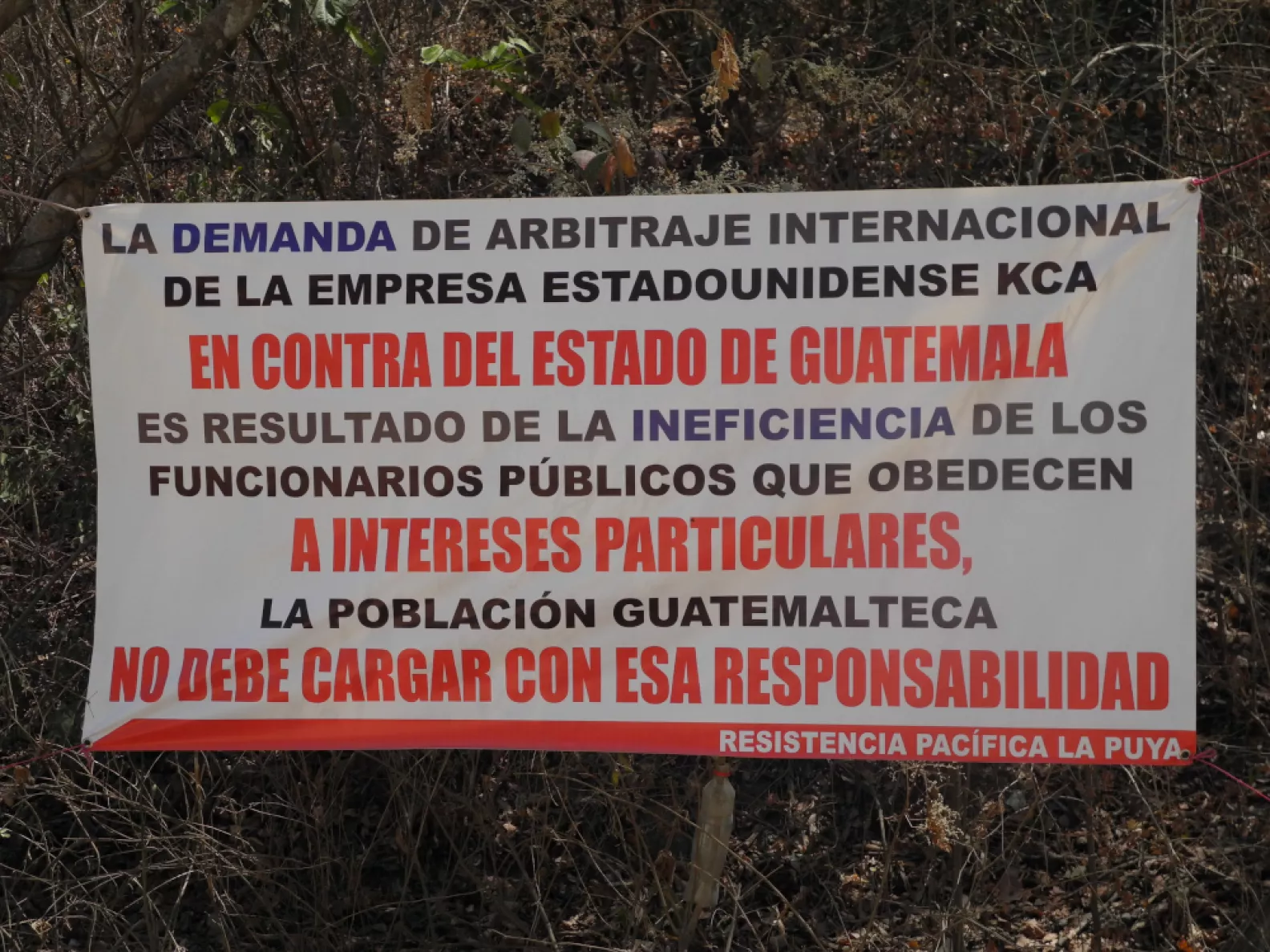
Unable to continue its operations, KCA turned to an international arbitration mechanism – a provision of the free trade agreement between the Dominican Republic, Central America, and the United States (CAFTA-DR), which the Guatemalan government signed in 2005 despite massive opposition from civil society organizations – to demand that the Guatemalan government bear the economic cost of the mine’s closure. The company filed a dispute before the World Bank’s International Centre for Settlement of Investment Disputes (ICSID), seeking $499 million from the Guatemalan state to compensate the company for its investment and the loss of its alleged future profits.2
After a 7-year process, “the arbitration tribunal concluded that Guatemala did not violate its international obligations to protect investments, recognizing that the project’s suspension was the result of domestic judicial decisions and a genuine social conflict, not one arbitrarily created by the State.” The ruling establishes that a state is not obligated to compensate a company for the suspension of a project that faces public rejection, that the defense of the territory cannot result in a financial burden for the country, and that community resistance does not justify international financial sanctions.3
On December 28, 2025, the Peaceful Resistance La Puya held a press conference at the encampment, which they have maintained in front of the entrance to the mine for years. At the press conference, they welcomed the ICSID ruling but also made clear that they will remain vigilant “until the Progreso VII Derivada project has been permanently canceled” and in light of possible new mining licenses being granted in the region. “We feel satisfied and vindicated in our peaceful struggle, knowing that KCA lost its bid to make millions of dollars through this international arbitration process, which it initiated knowing full well that it would never win the consent of the communities that have always said no to its unfeasible project—a project that the mining company couldn’t even defend it in an arbitration system designed to protect the investments of transnational corporations.”4
1 For more detailed information, we recommend: Solano, L., Moore, B., and Moore, J., “Mining Injustice Through International Arbitration: Countering the Arguments of Kappes, Cassiday & Associates Regarding Their Gold Project in Guatemala,” Institute for Policy Studies, Earthworks, 24 August 2020. This report evaluates and provides evidence that challenges the claims made by KCA in its ICSID claim and addresses its omissions, such as State authorities’ use of force against the Resistance.
2 PBI Guatemala, International Arbitration against the Guatemalan State: The El Tambor Mine Case, Bulletin 43, June 2020.
3 Mazariegos, D., Resistencia Pacífica La Puya manifiesta satisfacción tras fallo arbitral favorable al Estado de Guatemala, Prensa Comunitaria, 28 December 2025.
4 Comunicado de la Resistencia Pacífica de la Puya, La Resistencia Pacífica de la Puya, a la comunidad guatemalteca e internacional, ante la decisión del tribunal internacional de arbitraje (CIADI), en el caso KCA v. Guatemala, informa, Facebook Resistencia Pacífica de la Puya, 28 December 2025.