
After receiving their request for accompaniment in late 2025, we began accompanying the National Network for the Defense of Food Sovereignty (REDSAG) and their struggle against monoculture plantations on the southern coast in April 2026. Below, we share their work with you.
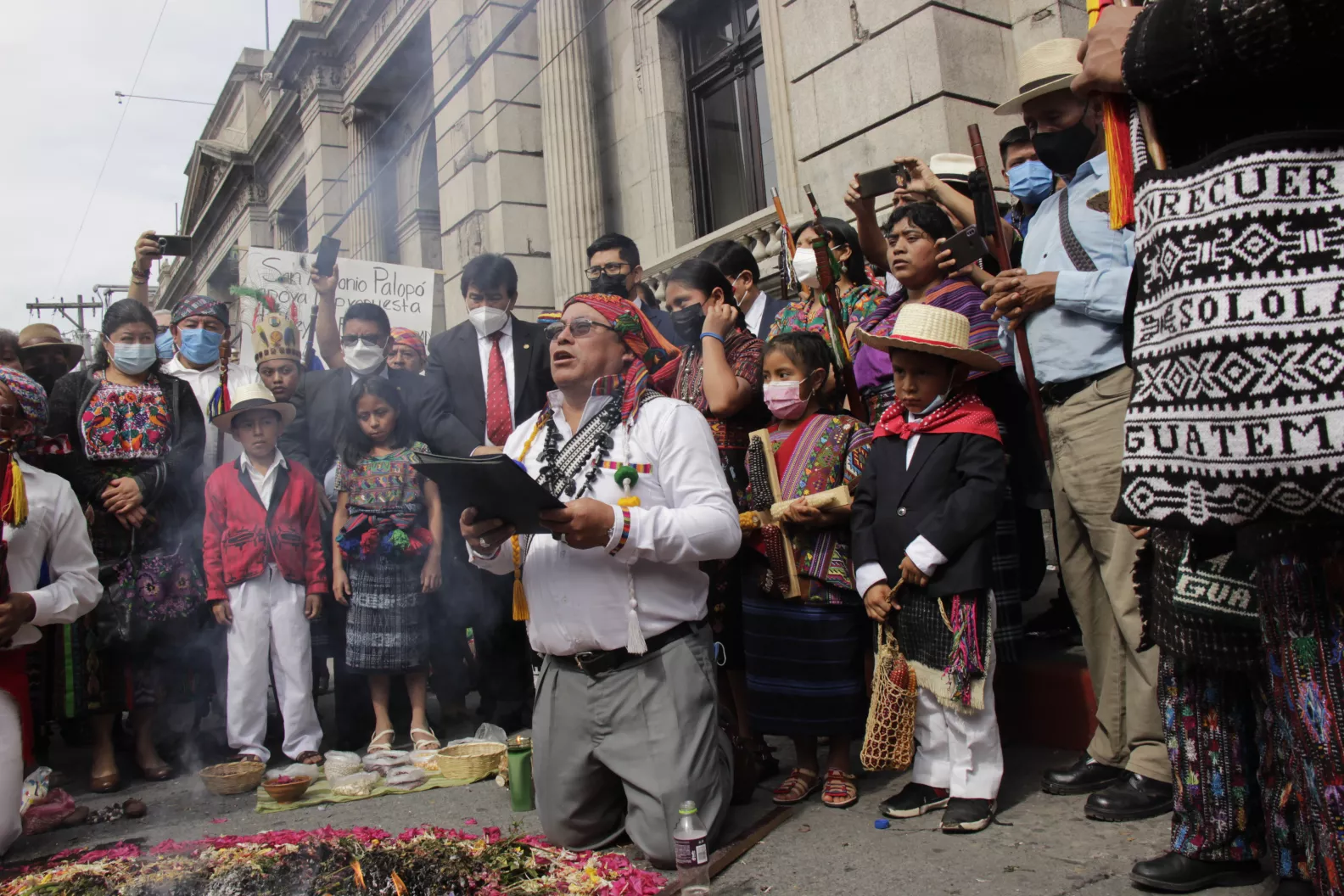
Peasant agriculture plays a fundamental role in the global food supply: 70% of the food supply comes from small-scale production.1 As in other countries, Guatemala relies heavily on family farming for food security. However, even though peasant communities—the vast majority of whom are Indigenous—produce most of the food consumed in the country, these communities’ rights to self-determination and food sovereignty are deeply underrecognized. REDSAG has identified and addressed this issue for more than two decades, working to secure recognition of food sovereignty, a fundamental right for Indigenous peoples, and to defend the rights of Guatemala’s peasant and indigenous communities.
REDSAG was founded in 2004 with the aim of coordinating peasant social organizations, groups, and movements that share a common vision for establishing food sovereignty, defending biodiversity, and protecting the rights of indigenous peoples and peasants. It operates nationwide and is organized into six regions: Petén, Alta Verapaz, Baja Verapaz, Eastern, Central, Southern, and Western. Since its founding, REDSAG has promoted proposals, strategies, and actions aimed at defending food sovereignty and the fundamental elements that underpin it, such as land, territory, water, seeds, and other natural resources essential to life and peasant agriculture.
Although the Network initially addressed food security issues, it soon decided to focus exclusively on food sovereignty due to the governments’ poor practices in ensuring food for their peoples. “The food system is always subject to many corporate interests. Everyone consumes food. The capitalist system that dominates us takes advantage of this,” explains David Paredes, coordinator of REDSAG. 2 “Food security is about addressing the problem of hunger from a capitalist perspective. The goal is to deliver food…to ensure that the population has access and to provide this food security. But the issue we see is that, when the discussion is about food security, no distinction is made about where the food comes from.” David explains that genetically modified seeds are distributed to communities and families as part of food security projects, with assurances that they have been “improved” and that people will be able to produce and sell more using them. However, these genetically modified seeds contain chemicals that reduce the nutritional value and also pose a health risk to those who consume food grown from them.
The use of genetic modification technologies on seeds is relatively recent and is still in the experimental phase. Thus, long-term impacts continue to be the subject of debate and research. Because these are experiments, they are not as precise as claimed and can be dangerous due to potential genetic errors and mutations, posing a risk to the environment and human health. Furthermore, there is another risk: that genetically modified seeds could cross-pollinate with native seeds, causing severe contamination. This situation could lead to as-yet-unknown impacts, threatening the safety of agricultural workers who handle these seeds and those who consume them.3
Therefore, while the food distributed in the name of food security may alleviate hunger in the short term, the food does not provide enough nutrients and may even cause long-term harm to the body due to the chemicals it contains. In contrast, the concept of food sovereignty offers a different perspective. David explains that “it is very different to talk about indigenous peoples’ food systems. It means talking about a holistic relationship with all the elements of Mother Earth, including the microorganisms we cannot see but that play an important role—and which chemicals kill. Talking about food sovereignty means using all of this to benefit our food. It is a holistic approach that respects the soil, the air, and the water. That way, our food is not contaminated with any chemicals.”
The use of native seeds is not only essential for ensuring a nutritious diet but also holds profound cultural and historical significance for indigenous peoples. It is also crucial for environmental preservation. Guatemala is one of the world’s 21 megadiverse countries, recognized for the richness of its ecosystems.4 Likewise, Guatemala is home to essential crops, like beans and corn, which form the basis of the Guatemalan people’s diet and are key elements of the country’s cultural and biological heritage.5 With this in mind, one of the main initiatives that REDSAG promotes is the defense and protection of ancestral knowledge and biodiversity, fundamental elements of food sovereignty. As David Paredes explains, “what food sovereignty does is pass on ancestral knowledge – a history of agriculture that indigenous peoples have practiced and that today forms the basis of our food supply.”6
Despite the importance of preserving native seeds and traditional production methods, peasant farmers face growing challenges stemming from the implementation of agricultural policies that promote the use of agrochemicals and genetically modified (GM) seeds. According to REDSAG, one of the most significant examples of the wrong direction agricultural policies have taken is the Plant Variety Protection Law, popularly known as the “Monsanto Law” due to its connection to the agrochemical company of the same name. The law sought to promote the protection of intellectual property rights over new plant varieties developed by so-called “breeders,” which were required to comply with a registration process.7 The law was passed in 2014; however, following fierce protests led by peasant organizations and food sovereignty defenders, the “Monsanto Law” was repealed three months after its enactment. The underlying reason for the strong opposition from peasant farmers’, indigenous peoples’ and civil society organizations is, above all, the law’s obvious goal of promoting seed privatization and the risk that such privatization poses to small-scale agricultural production.8
David Paredes points out that this law poses a threat to food sovereignty and the rights of peasant farmers. “The plant variety protection law safeguards large companies’ privileges. It talks about intellectual property; it talks about appropriating the rights of peoples. For example, an inventor can register an innovation, a trademark, or a seed variety, but they are disregarding and invisibilizing [ancestral knowledge]. It is a theft of ancestral knowledge.”9 REDSAG believes that the seeds that peasant farmers use today did not emerge all of a sudden or in isolation. They are the result of thousands of years of evolution through natural processes and human activities.10 This ancestral knowledge made it possible to develop the agricultural diversity that exists today and constitutes a collective heritage that has historically been developed by indigenous peoples. However, laws such as the “Monsanto Law” allow a company or individual to genetically modify a seed and subsequently register it under intellectual property rights in their own name.11 For indigenous peoples, this represents a form of appropriation and erasure of traditional knowledge, as it transforms a public good into private property. As a result, the law is seen as a step toward seed privatization and a threat to food sovereignty and farmers’ autonomy.
Although the “Monsanto Law” was repealed shortly after its introduction in 2014, Bill 6283 was introduced in 2023 to create the Protection of Plant Varieties Act, known as the “Monsanto Law 2.0.” The new initiative includes restrictions on seed exchanges between farmers and prohibits breeding new varieties. According to the El Observador Association, the initiative allows for the potential appropriation of genetic resources preserved by Indigenous peoples, whose work in protecting and exchanging seeds has been essential to preserving agrobiodiversity.12 This bill, which clearly favors corporate interests, is currently being debated in Congress. If passed, the law will have a very negative impact on rural communities, as it would undermine farmers’ autonomy over their own seeds, placing them in a situation of economic precarity and banning several traditional farming methods that these communities have been practicing for a long time.
In addition, REDSAG recently protested Government Agreement 53-2026, issued by President Bernardo Arévalo and the Ministry of Agriculture, Livestock, and Food (MAGA) on April 17, 2026, which would facilitate the expanded use of genetically modified seeds. They filed an injunction against this agreement before the Constitutional Court (CC), arguing that, in their view, the agreement could have “serious consequences for native and heirloom seeds in the territories and for communities’ food sovereignty,” as it reduces oversight, simplifies registries, and facilitates the importation of agricultural materials, thereby opening the door to foreign seeds, including genetically modified ones.13
In order to protect native seeds from policies that promote seed privatization, such as the Protection of Plant Varieties Act, REDSAG has developed and submitted a proposal titled “Biodiversity and Ancestral Knowledge Bill.” This initiative, also known as the “Law of the Peoples,” seeks to protect ancestral knowledge, practices, and wisdom, and to put an end to the development of an economic system that seeks to exploit natural resources. The bill stresses that one of the principles of the peoples is to respect the Maya worldview, a body of knowledge and wisdom that connects us to biological diversity.14
“Indigenous peoples’ and peasant farmers’ cosmovision is based on harmony, respect, and the preservation of all forms of life. We understand that we are connected to all forms of life on Mother Earth and in the Cosmos. That is why we are firmly committed to the defense, preservation, and care of the biodiversity found in our territories. For millennia, we have preserved them in harmony. With our proposal, we seek to halt the advance of an economic system that seeks only to profit from natural resources, without regard for the future of new generations or the harm we are causing to our Mother.”15
The “Law of the Peoples” establishes the right of indigenous peoples and peasant farmers to free, prior, and informed consent regarding the use of traditional knowledge, and seeks to strengthen the traditional mechanisms used to preserve these practices. In addition, the bill proposes penalties and bans on the importation and commercialization of living modified organisms or genetically modified organisms that threaten ancestral knowledge and biodiversity.16 The bill was submitted to Congress and is currently awaiting a decision. Bills like this are essential in Guatemala’s current context and in light of corporate interests, not only to protect the environment and promote the natural development of native seeds, but also to safeguard the autonomy of peasant and indigenous communities and traditional agroecological methods.
1 Samberg, L. H.; Gerber, J.S.; Ramankutty, N.; Herrero, M. and West, P.C., Subnational Distribution of Average Farm Size and Smallholder Contributions to Global Food Production. Environmental Research Letters, 2016.
2 Interview with David Paredes conducted on 13 June 2026.
3 Bravo, E., Cortando y pegando genes para manipular la vida. La edición génica. Sus peligros y normativa en América Latina. Acción Ecológica, Naturaleza con Derechos y Alianza Biodiversidad. April 2025.
4 Asociación El Observador, Boletín Enfoque Análisis de situación No. 100. Semillas Autóctonas vs. Transgénicos. Guatemala, 24 November 2025.
5 Ibid.
6 PBI Guatemala, ACÉRCATE September 2023.
7 Asociación el Observador, Op. Cit.
8 Ibid.
9 PBI Guatemala, Op. Cit.
10 REDSAG, Protejamos nuestra Biodiversidad. Documento mediado de la Propuesta de Iniciativa de Ley de Biodiversidad y Conocimientos Ancestrales, 2021.
11 PBI Guatemala, Op. Cit.
12 Asociación El Observador, Op. Cit.
13 Espinoza, I., La REDSAG presenta acción legal contra Arévalo por acuerdo que facilita semillas transgénicas, Prensa Comunitaria, 20 May 2026.
14 Red Nacional por la Defensa de la Soberanía Alimentaria (REDSAG), Protejamos nuestra Biodiversidad. Documento mediado de la Propuesta de Iniciativa de Ley de Biodiversidad y Conocimientos Ancestrales, 2021
15 Ibid.
16 Ibid.