
Image
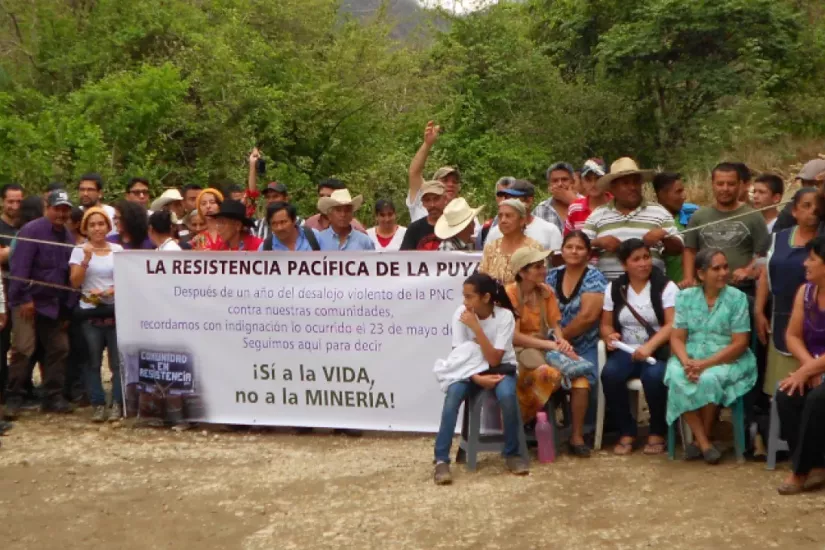
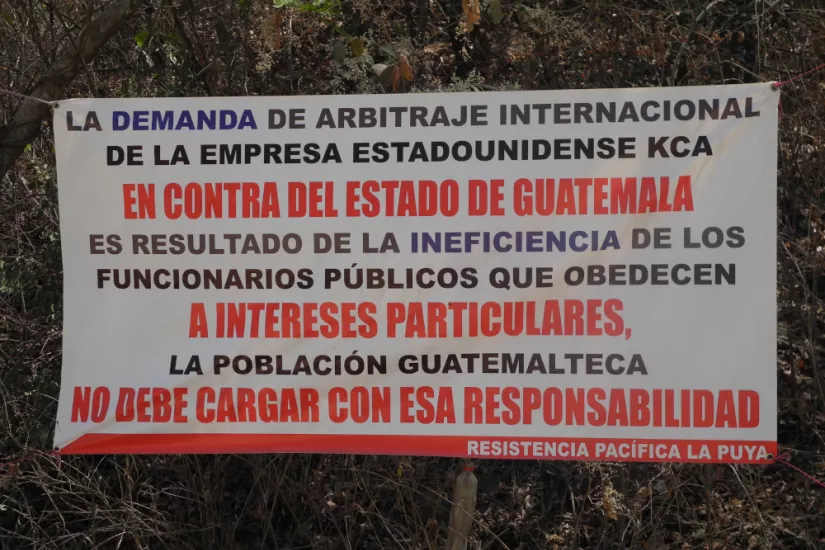
On December 23, 2025, the Peaceful Resistance La Puya, which PBI accompanied from 2013 to 2024, finally received the news they had been waiting for for seven years: the arbitration tribunal rejected the multimillion-dollar lawsuit filed by the mining company Kappes, Cassidy & Associates (KCA) against the Guatemalan State. The Resistance’s participation in this process was crucial to the State’s victory in the arbitration. Their collaboration with the State’s legal team enabled them to provide evidence proving the exact opposite of the company’s allegations—namely, that the Guatemalan State had used every tool at its disposal to facilitate the mine’s operations, even resorting to repressive measures and violence against members of the Resistance. However, even with these extreme measures, the State and the company failed to subdue La Puya, whose courage, bravery, perseverance, commitment, and absolute rejection of mining in their territory brought the mine’s operations to a halt.
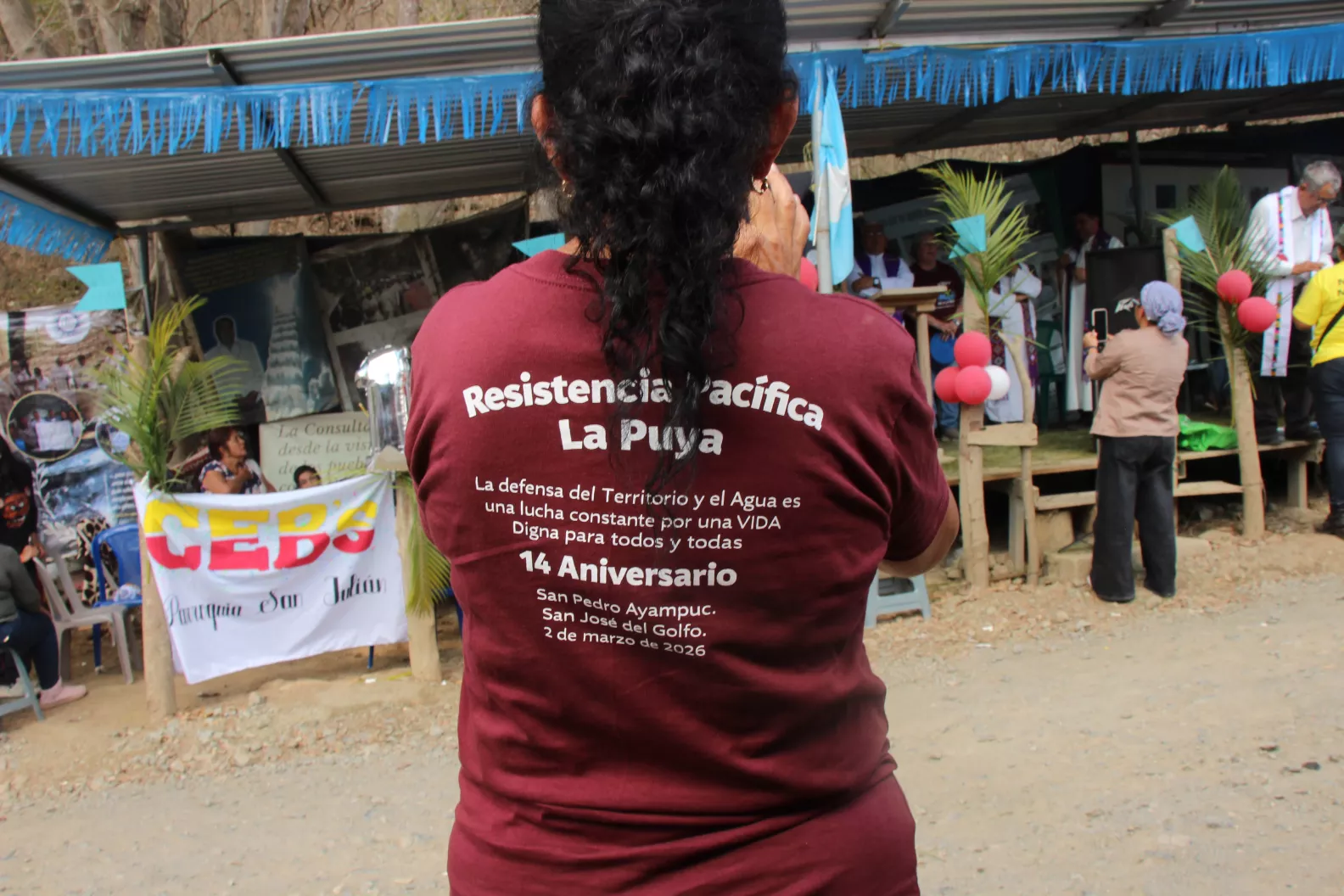
In March 2026, the Resistance invited us to its 14th anniversary celebration. We were delighted to attend the celebration, where we spoke with Felisa Muralles (Ms. Licha), José Ángel Llamas, and Ana Sandoval about their struggle and their involvement in the various stages of the arbitration process.1
PBI: How did you find out about the company’s lawsuit against the Guatemalan government?
Ana: In 2018, two international organizations, Institute for Policy Studies (IPS) and Edwards, contacted us to ask what we thought about the company’s notice of intent to file a lawsuit against the State. At that time, we knew nothing about it, and that’s how we began to learn more. From there, we began to exchange information with fellow activists in Santa Marta (in El Salvador) and learned about their experience with a company’s arbitration case against the Salvadoran State. That’s how we began to learn everything about arbitration cases and understand them a little better.
In 2020, the process of cancelling the license issued in 2016 was already underway. Four years had passed, but we were still waiting because the CC had not yet ruled on the injunction regarding the matter of consultation. And that was right when the CC issued its ruling upholding the lower court’s ruling and confirming that the right to consultation had been violated. That was when the company formally filed its lawsuit with ICSID and made its claims.
The company claimed that the government had not treated it in the same way as other companies when ruling on its legal proceedings. They also claimed that the government had not provided the company with enough security to allow its operations to continue. And the other claim, if I’m not mistaken, concerned fair treatment. That one has more to do with how the State treats the company in terms of investment. And so they filed the claim under the Free Trade Agreement, CAFTA.
PBI: How did the Resistance get involved?
Ana: By that point, we already knew a little more about the process; during the initial stage, when options were presented, we had already requested to be a non-litigating party to the proceedings. This means acting as a third party in order to file an amicus curiae brief. But our request was denied. Then, when the company formally filed its lawsuit in 2020, we reapplied to be a party to the proceedings so we could submit the amicus brief. We argued that we had information that neither the government nor the company would provide to the tribunal, since we were the direct victims of the situation, having been subjected to abuses by both the government and the company, and neither party was going to provide that information to the tribunal. In the end, they rejected our request on the grounds that we lacked standing. After that, the government reached out to us, trying to establish a connection with the Resistance; they asked us to visit and talk about the arbitration issue. That all took place over the course of a week.
PBI: Given past conflicts with the State, how did the Resistance react to this request?
Ana: Well, at first, we told [the State] that we were just going to listen to them, since they had already brought their proposal: they wanted to include us in their defense. This was during the Giammattei administration. So, at that meeting, we listened to them and explained that we had to think it over before making a decision. We explained everything the State had done to us –the repression, the court cases. And then the lawyer for the State said, “We already know; we’ve read a lot about you. In fact, we’ve already discussed you in the proceedings, and certainly in the government’s brief in response to the lawsuit, the government has already recognized the Resistance and discussed the importance of La Puya’s work at length.”
Ms. Licha: That was quite an issue for us, because people didn’t agree with sitting down with the enemy. We felt it was wrong to offer them support after they’d sent forces to repress us; it was a conflict. In that place [at the encampment], we gathered, and our fellow activists said, “No, the State repressed us. We can’t sit down with the State. We’re not going to cooperate with them.” It was an ugly clash, but the people who were most against it were those who were a little more removed from the situation, who hadn’t endured the same suffering as we had. We had already gone through different phases, different training sessions, and different awareness-raising processes. So, we managed to reach an internal agreement: we decided that yes, we had to participate in order to set a precedent. We came to the conclusion that we are all part of the State, and that if the State lost, we would all lose.
We reached that agreement, and we gave [the government] all the information we had; three witnesses testified to give them all the details about how the State had repressed us and supported the company. All of this served to help the State defend itself against the company’s accusation that it had not provided them with the necessary support that investors needed, given that the State’s repression against us was specifically in support of the company. Furthermore, there was evidence that there were police substations here, on both sides, guarding the entrances. All of this evidence reaffirmed that the State did indeed provide the company with the necessary support. We were confident from the start that this evidence would bear fruit. And it did.
José Angel: It was a complicated situation because our communities couldn’t quite come to terms with it when the PGN [State’s Attorney] asked us if we could help them by sharing our accounts of the different situations we had experienced. So, during an internal meeting, we talked about it a bit because it’s not easy to support an enemy—after all, the State had practically become our enemy. But seeing that the goal was to win that lawsuit, we decided to participate. And we succeeded in getting a majority vote.
We appointed representatives to give their statements and present all the evidence showing that the government had, in fact, defended the company, because that was one of the accusations made by the company—that the Guatemalan State had not complied with the commitments or agreements it had entered into through the Free Trade Agreement to allow companies to carry out the project. So, that was a lie the company was presenting before the arbitration body. And they submitted all the evidence they could, along with our fellow activists’ testimonies—which were ultimately admitted, first virtually and then on two occasions in person. I believe that’s how the judges realized that the company had indeed lied—it had always lied—both when it first entered the communities and later in its attempt to win the case against the Guatemalan State. But thanks to the communities’ participation, they were able to prove that all of that was false and that we were peacefully defending life. That was what had the greatest impact; I believe that’s what led to the favorable outcome in this lawsuit.
PBI: Can you tell us what the State’s repression and attacks against you consisted of?
José Angel: Well, first of all, they tried to forcibly evict us while we were engaged in peaceful resistance. During the first attempt, there was no violence, but during the second one, they used tear gas against the people. In 2014, we experienced the third round of repression, and it was extremely brutal for the people, because [the state forces] did not follow protocol for the use of tear gas. They completely violated the rules and did so against the people; that was one of the situations that was especially painful for us. But despite all that, we reached a consensus to support the State’s defense in the arbitration, since we concluded that if we lost that case, the entire country would suffer. That is why we agreed to participate. It was this peaceful approach that we used to resist and resolve the situation. This approach proved very effective and prevented bloodshed during the repression, because the PNC [National Civil Police] forces came down hard on us—several members of the Resistance were injured—but our responses and actions were always peaceful. Yes, on May 23, 2014, around 36 comrades were injured. The injuries ranged in severity, and some of our fellow activists were seriously wounded. One woman was struck by two grenades. Another had to undergo surgery to remove part of her skull after a projectile struck her forehead. Yes, it was a very difficult day. After that incident, the PNC spent over a year here protecting the company, to the point that they set up two camps here, at the entrance to the mining project. We had documented all of that.
We managed to request public information and learned that the Ministry of the Interior had already spent more than Q850,000 on such operations to protect the company, which is sad because the company did not benefit the country at all—it only gave Q500 to each municipality (San Pedro de Ayampuc and San José del Golfo) as royalties for the time it operated there.
PBI: Q500 a month?
José Angel: No, during the entire time they were operating. That’s what I found out. Meanwhile, the Ministry of the Interior had already spent more than Q800,000 on repressive measures, in addition to the support it provided to the company. It’s unfortunate, but companies never leave any profits for the Guatemalan State or for other countries. One such example is what happened with the company, Perenco. Guatemala lost millions of quetzales while the company walked away with the wealth. This is happening in all the communities where there are mining projects, since not only does it wear communities down, but it also wears down institutions by forcing them to support the companies. Not many people know about this, but it’s the reality. These projects leave nothing good behind for Guatemala or for communities.
PBI: What tricks did the company use? What evidence refuted the company’s claims that the government failed to fulfill its obligations?
Ana: All the damage the company has caused since it arrived. The way they imposed the project by hiding information. The military personnel who were in charge at the beginning, and how they, too, created division within the communities. The failure to comply with environmental and social impact assessments; there was an inspection conducted by the Ministry of the Environment in 2015 or 2016, and they found that the company was not complying with more than 150 standards. That inspection was also based on the environmental impact assessment. Furthermore, some believe that the environmental impact study is of very poor quality and fails to include necessary information.
The police were there protecting them for more than two years, with a camp set up on the mine’s property. So what could the company possibly say if it had security the entire time it was operating? In 2016, the company filed an injunction against President Jimmy Morales, the police chief, and the Minister of the Interior, arguing that they were not being provided with sufficient security to allow them to operate. The Court ruled that the company’s argument was unfounded, because the project had been suspended by a court order; therefore, it made no sense for them to request security in order to operate.
There are many irregularities, starting with the way the license was granted. For example, in 2011, when we first learned about the project and began asking for more information, they told us no, saying there was nothing to see. And then, once we had set up the encampment set up here—after we’d been here for several days—we got a call from the Ministry of Energy and Mines and the Ministry of the Environment telling us, “Look, because of your persistence and the pressure you put on us, we tracked down the file that had gone missing. And yes, there is a mining license.” That’s how they told us that, yes, there was a license.
From the beginning, this company has had the full support and backing of the government, under different administrations. It has had institutional backing; otherwise, it wouldn’t have gotten to where it is today. So yes, one key point to note is that if the State hadn’t given the company everything it asked for, it would have lost the lawsuit. Because in the end, what the State argued was, “We did fulfill our obligations and provided security. Here’s all the evidence.” And the State also said, “The company acted illegally.” But of course, that’s because they allowed the company to do so.
PBI: Over the years, there has been a lot of defamation against you. Where did that defamation come from?
Ms. Licha: The defamation came from the communities themselves, from more distant communities, who used to say, “These people just want to make money.” They were negative people who supported mining. Those people still say, “So-and-so got this much, so-and-so got that much… he’s riding a motorcycle because the mining company gave it to him.” That defamation has spread, but we’ve been able to handle it because we have a clear conscience and because it’s not true. If they have evidence, they should show it to us—then we’ll take it seriously. As Lolita Chávez said, “I bathed in lard, so now these comments just roll off my back.” That’s how they try to defame us, to tear us apart, to upset us, and to make us give up. But thank goodness, we’re still as united as ever.
PBI: Did the lawsuit against the State lead to more defamation against the Resistance?
José Angel: Yes, the State itself—across three successive presidential administrations—accused us of being the reason it had been sued and was required to pay a large sum of money. But we have never felt guilty. In fact, the State has failed to defend its people, and that is why we, as community members, had to take on that responsibility—because the State did not. That’s why it’s taken such a toll on our communities. Those of us who consciously committed ourselves to defending our rights and opposing the mining project had to spend an average of two months a year here at the encampment, over the course of eight years. During the pandemic, people stopped mobilizing as much because it was no longer possible to travel to participate in the shifts. However, we felt a little more confidence because there were already lawsuits and legal processes underway. We believed the company couldn’t continue operating, but we weren’t entirely confident, because the company doesn’t respect Guatemalan laws. In fact, when the company was ordered to stop work on the project, they continued operating for several days until we community members stopped them. The police returned, but when they saw the order to suspend operations, they had to acknowledge that we were right and that the company could not continue working. So we believe that the company does not respect the law or comply with agreements, which is why we cannot completely abandon our encampment. They could try to force their way in, aided by the rampant corruption that plagues government institutions.
PBI: What was the cost of your commitment—of your time and your life—to the Resistance?
José Angel: Most of us work in agriculture, which meant that we had to spend our time in the resistance, instead of taking care of our crops. We suffered financial losses. A lot of financial losses, because we have to work every day just to make ends meet. I think our way of life actually worked in our favor—we usually worked Monday through Saturday, but with this struggle, we had to adjust and work on Sundays as well. When they were repressing us, our communities had to be here and move back our harvest dates in order to make time for the Resistance. Because when [the company] didn’t see many people there, that’s when they’d intimidate us even more. So yes, it was a huge financial strain, and it was only thanks to the solidarity of each and every family that we managed to survive and keep the movement going.
PBI: And how many families participated? How many communities?
José Angel: We don’t have the exact number of families, but about 13 communities were present, along with many families. Entire families would sometimes come here, and we also received support from some relatives abroad who donated money, because it wasn’t just a matter of devoting time. We also had expenses for transportation, food, and legal fees related to the criminalization of 18 people, three of whom were sentenced.
Our communities organized different activities, including raffles, sales, and contributions from relatives abroad. We managed to raise enough money to cover the bail for our fellow activists who were sentenced to nine years in prison, at a cost of 9 quetzales a day. That amounted to more than Q90,000, which we paid as bail so that our comrades would not go to prison. We are not community members who break the law; we have always been law-abiding. Our comrade was so deeply affected by the situation that he became depressed, and although we responded to all these challenges by working together, he suffered a stroke. He was partially paralyzed for two years before eventually passing away. He is no longer with us.
We paid more than Q90,000 so our comrades could avoid jail time for the alleged crimes that were pinned on them. But the judge also issued a ruling ordering them to pay the plaintiff, who was from the company, Q20,000 for each of our colleagues. So that came to another Q60,000. We haven’t paid that yet because the ruling isn’t final. We hope it will be dismissed someday.
Our communities stood united, and we managed to raise that money. We are still waiting for the court order, but ideally, we won’t be ordered to pay. It has been a very difficult situation. Some of our neighbors who worked with the company defamed our communities. The company used them just to identify people and stir up trouble, claiming that women, as well as men, were coming here to engage in prostitution. Their efforts were unsuccessful, but they did have a significant impact.
PBI: During the arbitration proceedings, did the State acknowledge any responsibility for the violence and repression directed against you?
Ana: Not as the State. What the State does acknowledge is that there has already been environmental damage; in fact, it conducted a study to quantify how much damage was done. As part of the lawsuit, the State filed a counterclaim against the company for $2 million in environmental damages. The State also conducted an analysis of the social unrest caused by the company’s arrival. The State also recognizes the legitimacy of the Resistance, and the studies and reports they have conducted here cite the Resistance as such. They actually cite several of the documents that have been published. This is important to us now, as we reach the end of the case, because we believe this could be used in other cases. For example, there is the issue of the consultation. The ruling states that consultation must take place, and the company can only continue operating if it demonstrates that there are no adverse effects on the communities. The State has already proven such impacts in an international tribunal. Of course, these are two different proceedings—one has nothing to do with the other—but the State has made these arguments. I think that’s very important and should be brought into this other proceeding. The other issue is repression. Ultimately, if the State had not repressed us the way it did, they would not have won the lawsuit. The State won the lawsuit because of everything they did to us. I think that’s very important.
PBI How did you find out about the ruling?
José Angel: We had an agreement with the PGN that they would inform us of the arbitration results. On December 23, 2025, the PGN broke the news to the lawyers advising us—the Human Rights Law Firm (BDH)—and they immediately informed us that we had won the arbitration, that the State would no longer have to pay that massive sum, and that the arbitration panel was requiring the company to pay a small amount, Q380,000. That’s really a pittance, but at least it covers something, because the State’s legal defense cost millions—they hired an international firm to represent them, an Argentinian lawyer. While we don’t know the exact amount, we do know that State spent millions on its defense.
Ms. Licha: The day before Christmas Eve, Edgar [from the BDH] called to tell us that the PGN had called and said, “Thanks to you, we won the lawsuit.” We didn’t even know what to do—cry, laugh, or thank God. We had very conflicting feelings because we were saying, “What a tremendous gift.” Even though we weren’t going to receive anything financially, we felt enormous satisfaction because we set a strong precedent, showing companies that they won’t always win. It was a huge achievement, although there was some confusion—people were speculating about how much money the Resistance would receive and how much the country would get. So we kept explaining and explaining that neither the State nor the Resistance would receive anything. There simply wouldn’t be any payment, because those agreements are unequal: if the company won, it had to be paid, but if the State won, it wouldn’t be paid. So we had to explain that over and over, although people still didn’t believe us. They’d say, “But they are going to give a share of the money to the State, aren’t they?” And we’d tell them, “Yes, they’re going to give the State a tiny amount, but that’s just what the State spent on defending itself.”
“We are not going to receive financial compensation, nor do we want any, because all that we have given, we have donated to life, to nature. We don’t care that we aren’t receiving any financial compensation. We feel more content if we get nothing—that way, there will be no excuse to defame us.”
PBI How does this ruling make you feel?
José Angel: For us, it’s the satisfaction of knowing that we did the right thing and that, despite the injustices perpetrated by the government, we protected the country from having to use our tax dollars to pay the amount the company was suing for. That was one of the reasons we began working with the PGN on the defense. We hope that the money that ultimately did not have to be paid to the company will be allocated to healthcare and education for the people of Guatemala. We are quite pleased and feel motivated because our struggle has been worth it.
Ms. Licha: We are pleased that we did win. As I say in my poem, a tiny group of ants defeated a huge elephant. We felt like a handful of ants facing a huge monster. We tickled them, and those tickles stung, and now they’re furious because they lost their millions, and we feel an enormous sense of satisfaction at having won. As I said, we didn’t gain anything financially, but we gained a great deal of satisfaction and set a precedent for the country.
What we would have liked is for President Arévalo to at least say, “Look, I want La Puya to come here,” or “I’ll go to La Puya to thank them for what they did.” That’s the least he could do, but he hasn’t done it. Nonetheless, we already have that sense of satisfaction, and no one is going to take it away from us.
Ana: There was a lot of joy, and I think it really lifted everyone’s spirits. There were a lot of expectations about whether or not the State would win, but upon hearing the news—and especially after reading the PGN’s statement saying that all the claims were dismissed—yes, it brought us a lot of joy and really lifted everyone’s spirits. And of course, this also sets a precedent for other territories and could have a domino effect. We’re pleased in the sense that not only have the national courts told the company it’s doing things the wrong way, but an international tribunal is also saying that none of its claims hold up. Yes, I think that part is important, but we also can’t overlook the fact that the State was successful in this process because it gave the company everything it asked for.
PBI: And now the only thing left is the consultation.
José Angel: Yes, the CC granted us the injunction, and then ordered that the consultation be held. But the State has not handled this properly, since, to begin with, the authorities refused to recognize us as indigenous peoples. They went to one community [Nacahuil] that is part of the Resistance and said they would only hold the consultation with them. However, the community members contacted us immediately and told us that they would not participate unless all the communities were involved. If the process begins, it will be difficult to get them to accept us as community delegates representing the indigenous peoples.
We reached some agreements on how to carry out the consultation, but then there was a change in the administration. This administration took a long time to appoint new staff. Once the staff was appointed, three meetings were held with the person in charge of conducting the consultation on behalf of the MEM [Ministry of Energy and Mines]. Also, the minister is being criminalized because he was the president of the 48 Cantones of Totonicapán [Luís Pacheco], who began the struggle to allow the Arévalo administration to take office. They went and put him in jail because of the persecution he faced from the Public Prosecutor’s Office, and so the process was postponed again.
To date, they haven’t appointed anyone in charge, but we recently received a notice from the MEM stating that they needed us to restart the process. We have now agreed to hold the first meeting on March 15, where they will introduce the new staff members who will oversee the process and ensure that it moves forward. After all, this is an order issued by the CC, and it must be complied with. However, this is no longer a matter of prior and informed consultation; rather, it is about remedying the damage the company has already caused, because there is nothing “prior” about it. So really, they are hoping for a process that will address the damage that has already been done.
PBI: Have you sought advice from other communities that have gone through this process? How do they organize?
José Ángel: Yes, we are in communication with them, but all of us are at almost the same level. Consultations have not taken place in the vast majority of communities. Instead, processes have been carried out, but results have not been made official. There are no regulations governing how consultations should be conducted. So, while we do share information, the aim is to move the situation forward jointly at the national level.
PBI: And what do you hope to achieve from this process? How long do you think it will take?
Ms. Licha: No clue, because we’re the ones who will set the date. They agreed that we would set the date. Indigenous peoples choose dates based on what the Maya calendar and the time keepers say. So, we have asked them when we could meet, what dates would be best. They agreed. So now they’ll just have to wait, because we’re the ones setting the date.
Ms. Licha, Mr. José Angel, and Ms. Ana, we truly appreciate your time, dedication, and admirable efforts, and we wish you strength, perseverance, and success as you move forward on your journey.
1 Interviews conducted on March 8, 2026.